Cost Restore Georgian Six Panel Door: 2025 Guide
By Daniel Fitzpatrick, Master Craftsman · Guild of Master Craftsmen
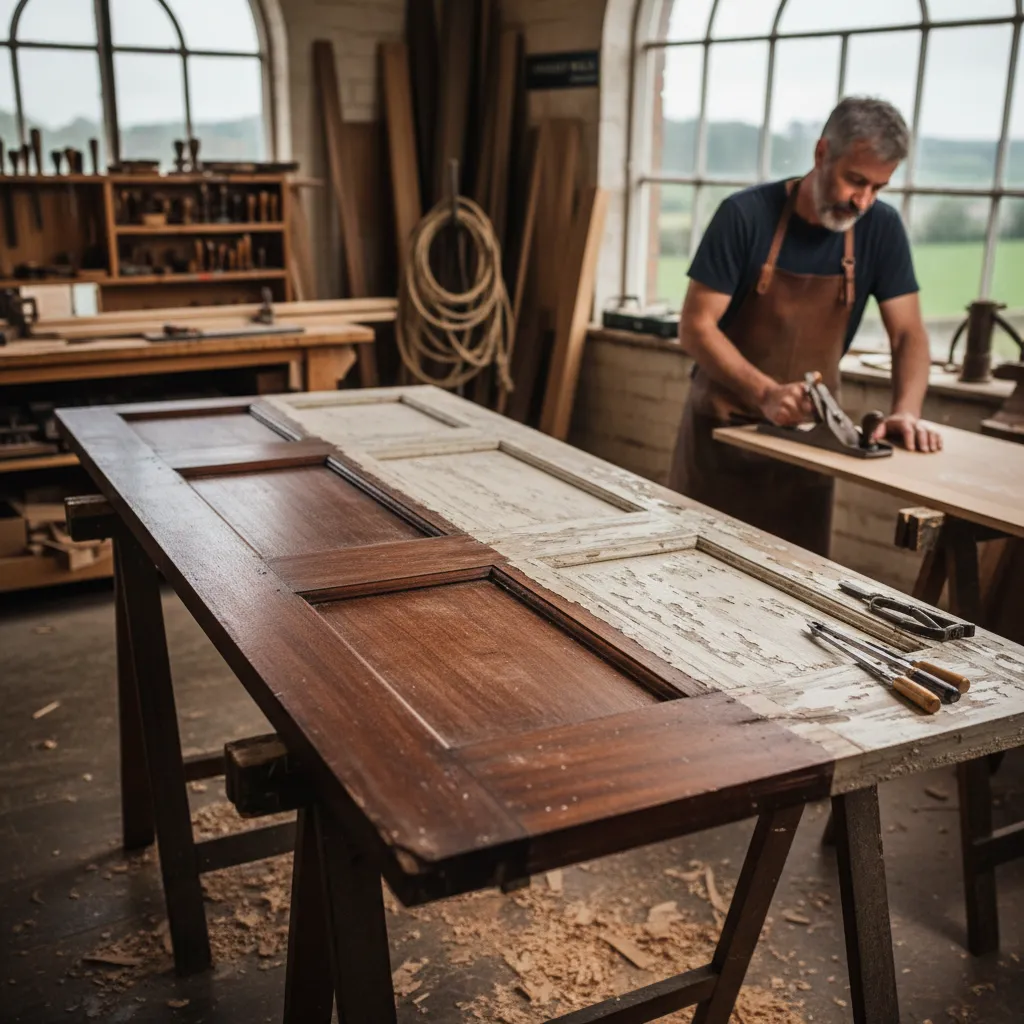
Quick answer: cost restore georgian six panel door
What you can expect to pay
The cost to restore a Georgian six panel door comes down to what is actually wrong with the timber.
A sympathetic strip, splice and refinish on a sound 1780 door in a West Yorkshire townhouse usually sits between £750 and £1,400. A door needing new lower rails, replicated mouldings and mortise repair runs £1,400 to £2,200. Source: Historic Environment Scotland guidance on traditional timber repair.
A Georgian pine door that has only lost its finish and shows tight joints sits at the low end. The moment lower panels are punky, the lock rail is split, or mouldings have been planed off, every fix becomes a hand-cut operation. That is where quotes climb, and where corner-cutting leaves a door worse off in five winters.
Why the wide range
Three working decisions set the price before a tool touches the timber:
- How much to keep. A scarfed splice of the decayed rail in matching period pine keeps around 90% of the original board and costs less than a full rail replacement.
- How to finish it. A full chemical strip back to bare wood is a five-hour bench job. A light abrade and repaint in linseed oil primer takes an afternoon.
- Whether ironmongery stays. Re-hanging original H or HL hinges and re-lipping the existing rim latch adds roughly £120 to £180 in labour.
Repair or replace, the working rule
Across more than thirty years at the bench, the rule is straightforward: if more than half the door is sound timber, restore it. A like-for-like replacement in period pine starts near £1,800, and listed-building consent adds six to twelve weeks. Daniel Fitzpatrick's yard at Crossley Mills has kept original six-panel doors in service that arrived with every joint loose and a rotten foot, because the panels were still 22 mm of quarter-sawn pine.
Where the answer narrows
Two questions pin down the real number on your door: how much of the lower third is soft, and is the glazing bar profile still a recognisable Georgian moulding? Photograph the worst face, measure across each rail, and send both to the workshop for a fixed quote rather than a band.
The craft decisions that shape the final quote
Timber repair: splicing rotten sections and replicating period mouldings
When a Georgian six-panel door shows rot at the base of the stiles or around the lower rail, the affected section is cut out and replaced with new timber of the same species, usually old-growth pine matched to the original. The joint is a scarfed or housed splice, glued and pinned, so the repair sits flush and moves with the door through the seasons. Surface fillers and polyester body fillers are avoided on door faces because they trap moisture and fail within a few years.
Replicating the original mouldings is where the door's character returns. Each of the six panels is framed by a stuck bead or ovolo moulding run on a scratch stock or with a custom-ground iron. The existing profile is sampled, a blank planed, and a short trial run cut before committing to the full length. A single moulding sample takes an hour to shape by hand; the full door takes a day once the profile is dialled in.
Mortise and tenon joints, ironmongery and weatherproofing
Georgian doors were jointed with through or stub mortise and tenons, glued and wedged, never screwed. Loose joints are re-wedged where possible, and failed tenons are cut out and replaced rather than renewing the whole rail. Original ironmongery, including H or HL hinges, rim locks and brass knobs, is kept, cleaned and re-fitted unless the castings are broken beyond use.
Weatherproofing uses a rebated weather bar at the foot and either brush or silicone seals set into the staff bead and head. This keeps the door's appearance honest and avoids the tell-tale compression strip of a modern replacement.
For a written quote tied to your specific door, send photos and measurements via our contact page or call 01484 666 333.
Listed-building rules, dimensions and sourcing timber
Consent, conservation areas and matching original materials
Any door set into a UK listed building, or one within a conservation area, needs consent before fabrication, replacement or significant alteration. Historic Joinery Yorkshire prepares the drawings, timber samples and method statements that conservation officers ask for. Treatment selection follows the same logic: like for like, sourced to match species, growth-ring spacing and section size.
Original raised-and-fielded Georgian panels were almost always European red pine or American pitch pine. Identifying the species before specifying matters because a denser timber set next to a soft original creates a hard line that no amount of stain will hide. Daniel Fitzpatrick's rule after three decades on the bench: cut a small sample from the bottom rail, send it for identification, and only then order matching stock.
Reclaimed pine, standard six-panel sizes and what to specify
Standard Georgian six-panel external doors measure 762 × 1981 mm, 838 × 1981 mm or 914 × 2134 mm, with a typical 44 mm thickness. Internal versions follow the same widths but drop to 35 mm. These sizes are quoted because they sit within a millimetre of the original 1760–1820 norm, which keeps replacement doors fitting existing linings without re-casing.
The practical sourcing trade-off is between FSC-certified new pine and reclaimed timber. Reclaimed boards carry age, patina and the right shrinkage rate, but the usable yield from a single beam can fall below 30% once rot, sap pockets and ferrous staining are cut out. New FSC stock is faster to specify and arrives defect-free, yet it needs fuming or ageing to read as authentic against adjacent originals.
For most Georgian jobs the workshop specifies FSC-certified new pine for the hidden structural splices and reserves reclaimed boards for the visible panels and mouldings. Request a small graphite rubbing from the existing moulding before ordering so the profile lands within 1 mm of the original.
Talk to the workshop before you commit
Share photos and measurements for a fixed quote
Send clear photographs of both faces, the top and bottom edges, and a close-up of any damage or loose joints. Add the door's width, height and thickness in millimetres, plus a note on the timber (pine, oak or another species). From the Crossley Mills workshop, Daniel Fitzpatrick reads each enquiry by hand and replies with a written estimate, so you receive a number tied to your door rather than a generic price band.
Three measurements matter most: overall height and width, the bottom rail depth, and any panel thickness visible where a bead has lifted. Mark problem areas on the photos with a circled note; arrows save a round of clarification. If hinges, latches or a rim lock are still original, photograph them too, since their condition affects whether they are reused, repaired or matched with new ironmongery.
What happens on the inspection visit at Crossley Mills
Doors arrive at the workshop by prior arrangement, or are seen on site within roughly an hour's drive of Holmfirth. Daniel checks the joints, looks for shrinkage splits along the stiles, and tests the panels for soundness by gentle pressure rather than tap testing alone. You receive a short written report naming what can be saved and what needs splicing, with a revised figure if the scope changes after inspection.
Bring any original hardware you want retained. The visit is also the right moment to discuss paint stripping, draught-proofing and whether the door can be taken back to bare timber without damaging the period patina. Call 01484 666 333 or email enquiries@historic-joinery-yorkshire.co.uk to arrange a slot.
Sources
- Your Full Handbook for Bringing a Georgian Home Back to Life
- Reviving a Period Door, A Walkthrough with Ask This Old House
- What Should You Budget for Door Repairs? [Figures from 2025]
- Refinishing a Door, Adjustable Pricing Tool for 2026
- Typical Spending on Door Repairs Explained [Updated 2026]
- Door Repair Pricing for 2026, Front Doors, Interior Doors and Frame Fixes
- Heritage Timber Door Care Across New York, New Jersey and Connecticut
- An In-Depth Look at Refinishing Costs, with a Complimentary Estimate