What Is a Sash Window? Parts and How It Works
By Daniel Fitzpatrick, Master Craftsman · Guild of Master Craftsmen
What is a sash window? It is a window whose glazed panels, called sashes, slide in a timber frame instead of swinging open on hinges. In a traditional box sash, hidden cords run over pulleys to metal weights that balance each sash, so it stays put.
Sash windows are one of the defining features of period houses across Yorkshire, from Georgian town houses in York to Victorian terraces around Huddersfield. In our workshop at Crossley Mills in Honley we take them apart and repair them, so we know every piece by name. This guide explains the parts, how the weights work, how sashes differ from casements, and the downsides.
Key takeaways
- What is a sash window, in one line? A window with sliding panels (sashes) rather than hinged ones. In a double-hung window both the top and bottom sash move.
- In a traditional box sash, each sash hangs on cords that run over pulleys to hidden weights inside the box frame. When the weights are right, the sash stays where you leave it.
- The main parts are the box frame, the two sashes, the meeting rails, the horns, the parting bead, the staff bead, the pulleys, the cords and the weights.
- Old sash windows need regular care, but a sash that sticks, rattles or has a broken cord can usually be repaired rather than replaced.
What is a sash window?
The Society for the Protection of Ancient Buildings (SPAB) gives a clear definition: a sash window has one or more opening parts, called sashes, that slide rather than swing on hinges. The sashes usually slide vertically, hung on cords or chains and balanced by metal weights housed in a boxed frame (SPAB, Sash window maintenance).
SPAB also sets out the two common types. A single-hung sash window has only one moving part; a double-hung sash has two. In a double-hung window the bottom sash slides up on the inside and the top sash slides down on the outside. SPAB says sash windows were popular from the late 1600s and "epitomise Georgian and Victorian houses". Wikipedia notes that the oldest surviving examples were installed in England in the 1670s (Wikipedia, Sash window).
What does a sash window look like?
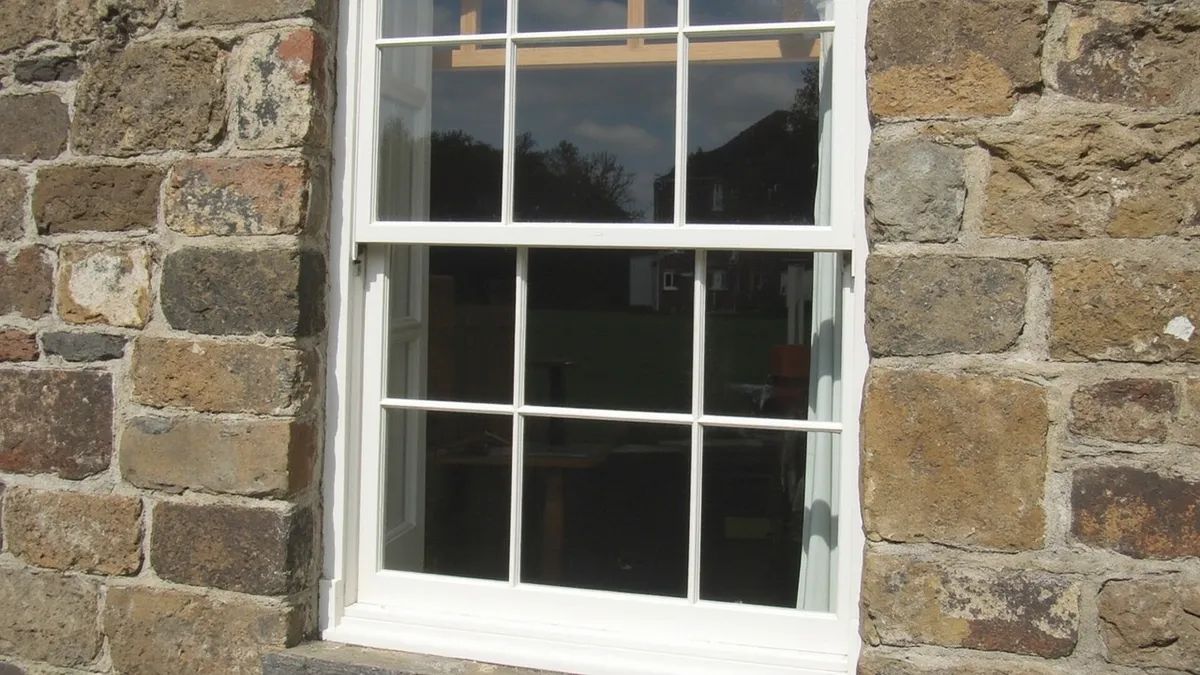
From the street, it looks like two glazed panels stacked one above the other, with a horizontal bar across the middle where the two sashes overlap. Many older windows are divided into small panes by thin glazing bars. Wikipedia describes the classic Georgian and Victorian arrangement as three panes across by two up on each sash, a "six over six" window, though not a fixed rule. The weights, cords and pulleys are hidden inside the frame.
What is a sash window made of? The parts explained
Answering what is a sash window really means understanding the box it slides in. Here are the parts of a sash window, labelled roughly from the frame inwards and from top to bottom:
- Box frame. The outer timber frame fixed into the wall. Its sides are hollow boxes that hide the weights.
- Pulley stiles. The vertical inner faces of the box frame that the sashes slide against. Each holds two pulleys near the top.
- Pulleys. Small wheels set into the pulley stiles. The sash cord runs over them.
- Upper (top) sash. The outer sliding panel. It slides down to open.
- Parting bead. A thin strip of timber set into a groove in each pulley stile. It keeps the top and bottom sashes in separate tracks.
- Meeting rails. The bottom rail of the top sash and the top rail of the bottom sash. They overlap when the window is shut, and the catch sits on them.
- Horns. Short extensions of the side pieces (stiles) of a sash, running past the meeting rail. They give extra strength to that corner joint.
- Lower (bottom) sash. The inner sliding panel. It slides up to open.
- Staff bead. The inside bead that holds the bottom sash in place against the parting bead.
- Sash cords. Cords that connect each side of each sash to a weight.
- Weights. Heavy metal weights that hang inside the box and balance the sashes.
- Pocket pieces. Removable pieces in the pulley stiles that give access to the weights.
- Cill. The sloping bottom of the frame, shaped to shed rain away from the wall.
What each part does, and what usually goes wrong with it:
| Part | What it does | Common problem |
|---|---|---|
| Box frame | Holds everything and hides the weights | Rot at the foot of the frame near the cill |
| Sashes (top and bottom) | Hold the glass and slide to open | Loose joints, rotten bottom rails, painted shut |
| Meeting rails | Overlap to close the gap in the middle | Fail to meet properly as parts wear or weights are wrong, letting in draughts and rattles |
| Horns | Strengthen the corner joint of the sash | Split or broken off, often from being knocked |
| Parting bead | Separates the two sashes | Worn or loose, causing rattles |
| Staff bead | Holds the bottom sash in place | Fixed too tight or too loose, painted over |
| Pulleys | Let the cord run smoothly | Seized or clogged with paint |
| Sash cords | Link each sash to its weights | Dry, frayed or snapped |
| Weights | Balance the sash so it stays open | Wrong size, or fouled inside the pocket |
| Cill | Throws rainwater clear of the wall | Wet rot, especially on exposed elevations |
What are sash window horns for?
Sash window horns are short extensions of the sash stiles that stick out below the meeting rail of the top sash, one on each side. Their job is to strengthen the joint between the stile and the meeting rail, which carries the weight of the glass when the top sash hangs on its cords. Fewer, larger panes put more load on that joint, which is why horns are common on later Victorian and Edwardian sashes and often absent on earlier ones with many small panes. When a sash is repaired or remade, match the original horn shape.
How do sash windows work?
Sash windows work on a simple counterbalance. Each sash hangs from two cords, one on each side. Each cord runs up over a pulley at the top of the pulley stile and down into the hidden box, where it is tied to a weight. Wikipedia describes the weight as a heavy steel, lead or cast-iron counterweight concealed in the frame, connected to the sash by a cord or chain that runs over a pulley at the top of the frame (Wikipedia).
The balance has to be right. SPAB advises that upper sashes should be about 0.5–0.9 kg lighter than their weights, and lower sashes 0.5–0.9 kg heavier, otherwise sashes will rise and drop on their own (SPAB).
Wikipedia also explains that opening the top and bottom of a sash window by equal amounts lets warm air at the top of the room escape and draws cooler air in at the bottom (Wikipedia).
SPAB also mentions the "Yorkshire light", a variation where the sash slides sideways without weights (SPAB).
What is the difference between sash and casement windows?
The difference is how they open. A sash slides in its frame. A casement window, as Wikipedia puts it, is attached to its frame by one or more hinges at the side, and swings open (Wikipedia, Casement window). Wikipedia also notes that casement windows were common throughout Britain and Ireland before the sash window was introduced.
- Space: a sash does not project into the room or the street when open; a casement does.
- Mechanism: a traditional sash relies on cords, pulleys and weights; a casement relies on hinges and a stay.
- Ventilation: a double-hung sash can open at the top, the bottom or both; a casement opens its whole leaf.
- Maintenance: Wikipedia notes that the sliding mechanism makes sash windows more vulnerable than casements to swelling, distortion and paint sticking them shut.
If your house has timber casements, our guide on repairing or replacing casement windows in a conservation area covers the choices.
What is the difference between a sash window and a frame window?
Part of explaining what is a sash window is separating the two things people call "the window". The frame is the fixed box built into the wall. The sash is the moving glazed panel that slides inside it. Every sash window has both.
The difference matters when you get a quote. "New sashes" means new sliding panels made to fit the existing box frame; "new windows" usually means replacing the frame as well. In the UK, Wikipedia notes that "sash window" and "box sash window" are used interchangeably for the same thing (Wikipedia).
What are the downsides of sash windows?
Wikipedia lists the traditional problems with solid wooden sash windows as rot, swelling or distortion of the woodwork, and rattling in the wind as the timber shrinks. It adds that these can be solved by careful repair and draught stripping, that sash windows are relatively high maintenance, and that well-maintained sash windows should last generations without needing parts replaced (Wikipedia).
Add sticking sashes, broken cords and heat loss through single glazing, and you have the usual complaints about old sash windows. On their own, none of these is usually a reason to rip the windows out. SPAB's advice is that sash windows in poor working order can be overhauled, which may mean replacing sash cords, patch repairing worn stiles, renewing staff and parting beads, or adjusting weights and easing pulleys (SPAB, Timber windows). SPAB also says good draughtproofing, including replacement parting and staff beads with seals, will rectify draughts and rattles caused by general wear and tear (SPAB, Sash window maintenance). That is what our sash window draught proofing service does. Glazing upgrades can be added too, and we can advise on what suits the building.
Sash windows in Yorkshire homes
Sash windows are common across Yorkshire: in stone-built Victorian terraces and mill buildings around Huddersfield and the Holme Valley, in the Georgian and listed buildings of York and Wakefield, and in the Victorian and Edwardian villas of Harrogate. The wet, exposed Pennine weather in the Colne and Holme valleys is hard on cills, bottom rails and paintwork. Whether you live in Holmfirth or York, knowing the parts makes talking about repairs easier.
Our rule of thumb: repair the box, then judge the sashes
When we survey a sash window, we look at the box frame and the cill first. Our rule of thumb is simple: if the box frame is sound, we recommend keeping it and repairing or remaking only the parts that have failed. Taking a box frame out of a stone wall is disruptive and loses original fabric. Sashes, beads, cords and weights can all be repaired, renewed or rebalanced on the bench. If your house is listed or in a conservation area, check with your local planning authority or conservation officer before replacing any windows.
A quick check you can do yourself:
- Open and close each sash gently. Do not force a sash that will not move; SPAB warns that forcing one often causes damage.
- Look at the cords. If one has snapped, the others on that window may not be far behind. SPAB says that if one cord breaks, it is worth replacing all those on the window.
- Check whether each sash stays where you leave it. A sash that creeps up or drops down suggests the weights are wrong or fouled.
- Press a screwdriver gently into the cill and the bottom rails. Soft timber usually means rot.
- Close the window and feel for draughts at the meeting rails and the sides.
Our step-by-step guide on how to restore a sash window shows what a full overhaul involves, and our sash window restoration service covers everything from re-cording to new sashes made to the original profile.
Free advice on your sash windows
If your sash windows stick, rattle or have broken cords, we can tell you which parts need attention and which can stay. Master craftsman Daniel Fitzpatrick, a member of the Guild of Master Craftsmen with over 30 years' experience in bench joinery and woodturning, oversees every job from inspection to installation. Advice is free.
Call 01484 666 333, get in touch through our contact page, or read more about our sash window restoration work. Our workshop is at Crossley Mills in Honley, and we cover Holmfirth, Huddersfield, York, Harrogate and many other towns in West and North Yorkshire.
Frequently asked questions
What is a sash window in simple terms?
It is a window with glazed panels that slide, usually up and down, instead of swinging open. In a traditional box sash, each sliding panel, called a sash, hangs on cords that run over pulleys to hidden weights in the frame. The weights balance the sash so it stays where you leave it.
Why do some sash windows have horns?
Horns are short extensions of the sash stiles below the meeting rail of the top sash. They strengthen the corner joint that carries the weight of the glass. They are common on windows with fewer, larger panes, where that joint takes more load. Many earlier sashes with lots of small panes have no horns at all.
Can old sash windows be made draught-free?
Yes, in most cases. SPAB says good draughtproofing, including replacement parting and staff beads incorporating seals, will rectify draughts and rattles caused by general wear and tear. Easing the sashes, re-cording and rebalancing the weights at the same time makes the window run smoothly as well as sealing it.