Door Stripping: Dipping vs Hand Stripping Explained
By Daniel Fitzpatrick, Master Craftsman · Guild of Master Craftsmen
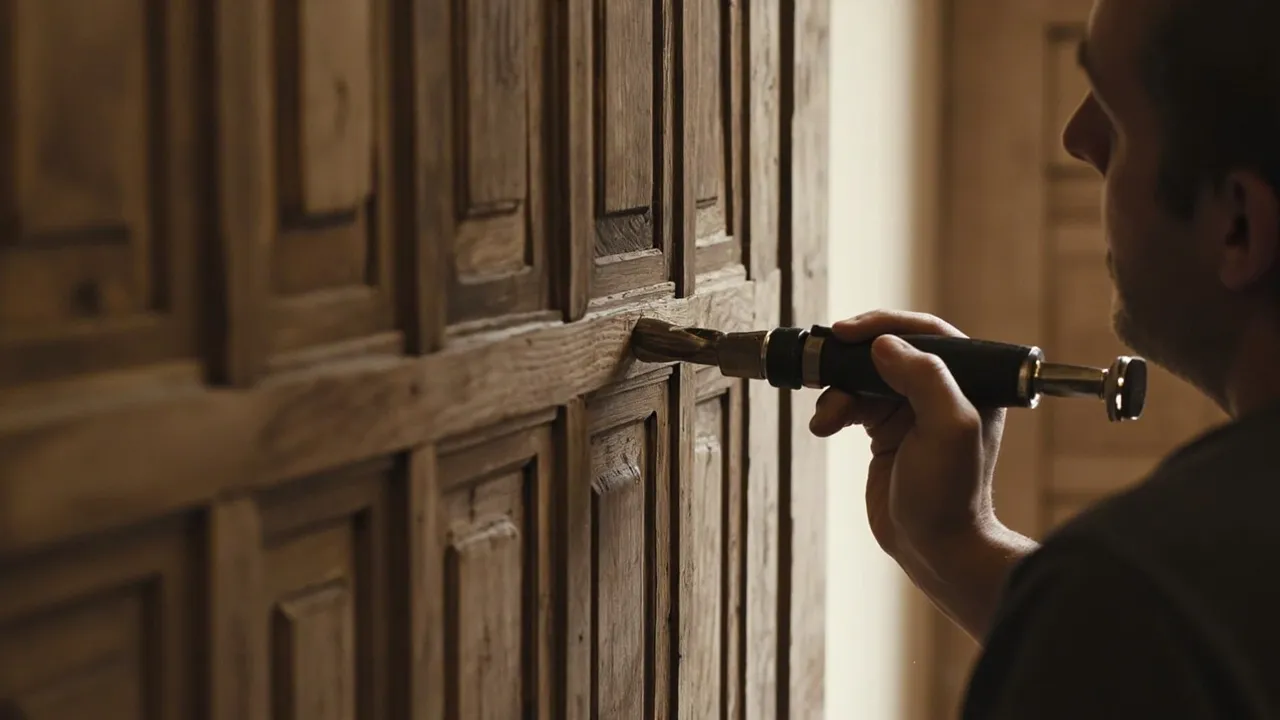
Door stripping means taking old paint or varnish back to bare timber. Dipping soaks the whole door in a caustic tank: fast, but it can soften glue, swell joints and raise the grain. Hand stripping is slower, but it helps keep the joints, mouldings and surface intact.
We strip doors by hand in our workshop at Crossley Mills in Honley, for period homes and civic buildings across Yorkshire. This guide explains honestly what caustic dipping can do to an old door, how careful hand stripping works, and when the best answer is not to strip the door at all.
Key takeaways
- Dipping doors is quick, but the SPAB warns that dipping in acid baths may raise the grain and, by softening the glue, weaken joints.
- Hand stripping works one face and one moulding at a time, so the door never gets soaked and the profiles stay crisp.
- Most old softwood doors were made to be painted. Stripping them bare is often the wrong look, not just a risk to the timber.
- Paint on a pre-1980s door may contain lead. Never dry sand it, and don't burn it off with a blowlamp.
What is door stripping?
Door stripping is the removal of built-up coatings from a door: paint, varnish, stain or all three. Each layer fills the mouldings a little more until the beads look soft and rounded. Stripping takes them off so the door can be repaired and refinished properly.
There are two broad approaches:
- Dipping. The door is taken off its hinges and lowered into a tank of caustic solution, usually caustic soda. The paint softens and is washed off with water.
- Hand stripping. The coatings are softened in place, face by face, with low heat or a stripping paste, then lifted with scrapers shaped to the mouldings. Residue is cleaned out of the corners by hand.
Both can leave a clean door. The difference is what happens to the timber and joints along the way.
Can doors be dipped and stripped?
Yes, and many are. Dipping doors is popular because it is fast. Caustic removers work by breaking down the chemical bonds in the paint film, and they must be neutralised afterwards or the new finish will fail prematurely (Wikipedia, Paint stripper).
The problem is that an old door is not a solid block of wood. It is a frame of stiles and rails held by glued mortice and tenon joints, with panels floating in grooves. The Society for the Protection of Ancient Buildings (SPAB) says dipping in "acid baths" may raise the grain and, by softening the glue, weaken joints (SPAB, Doors). Commercial tanks are usually caustic rather than acid, but the warning is about the same thing: soaking an assembled door.
What dipping can do to an old door
A dipped door can look fine when it comes back and still cause trouble later. These are the common problems:
- Loose joints. Old doors were often assembled with animal glue. Once that glue softens, the joints can open as the door dries, and wedges can drop out.
- Raised, furry grain. Soaked timber swells. When it dries, the surface can feel rough and needs heavy sanding, which takes off more of the original surface.
- Split or shrunken panels. Panels that swell in the tank and then dry out can crack or pull away from their grooves.
- Softened mouldings. Fine beads and ovolos can lose their crisp edges when the timber fibres are softened and then scrubbed.
- Colour change. Caustic can darken or grey timber, and it can discolour oak and other hardwoods.
- Residue in the joints. If the door is not fully neutralised, caustic left in the timber can later stop new paint or finish from bonding.
None of this is certain. A short dip can go well on a sound, plain door. On an old, glued, moulded door, it is a risk you can't undo.
How does hand stripping work?
Hand stripping takes longer, but it controls exactly what happens to each part of the door. In our workshop, paint stripping doors by hand usually runs like this:
- Test first. We check what the coatings are and whether lead paint is likely, and try the method on a small hidden area. SPAB advises always carrying out a trial in an inconspicuous location (SPAB, Paint).
- Remove the ironmongery. Knobs, locks and hinges come off and are kept for reuse.
- Soften the coating locally. We use low, controlled heat on flat faces and a stripping paste in mouldings and corners, working one area at a time.
- Lift the paint with shaped scrapers. Scrapers ground to match the mouldings follow each profile without cutting into it.
- Clean out the detail. Residue in the corners and beads is picked out by hand, then the surface is washed down and neutralised as the product requires.
- Let it dry and inspect. Once bare, the door shows its true condition. We repair any loose joints, splits or decay before any finish goes on.
Because the door is never soaked, the glue stays sound and panels don't swell. It is the method we used on doors at Grade I listed Morley Town Hall, where we stripped the old paint and stain, then applied a dark oak stain and a sprayed lacquer top coat. You can read more about that kind of civic work on our council and public sector projects page.
Door stripping: dipping vs hand stripping compared
Here is how the two methods of door stripping compare on an old, painted panel door:
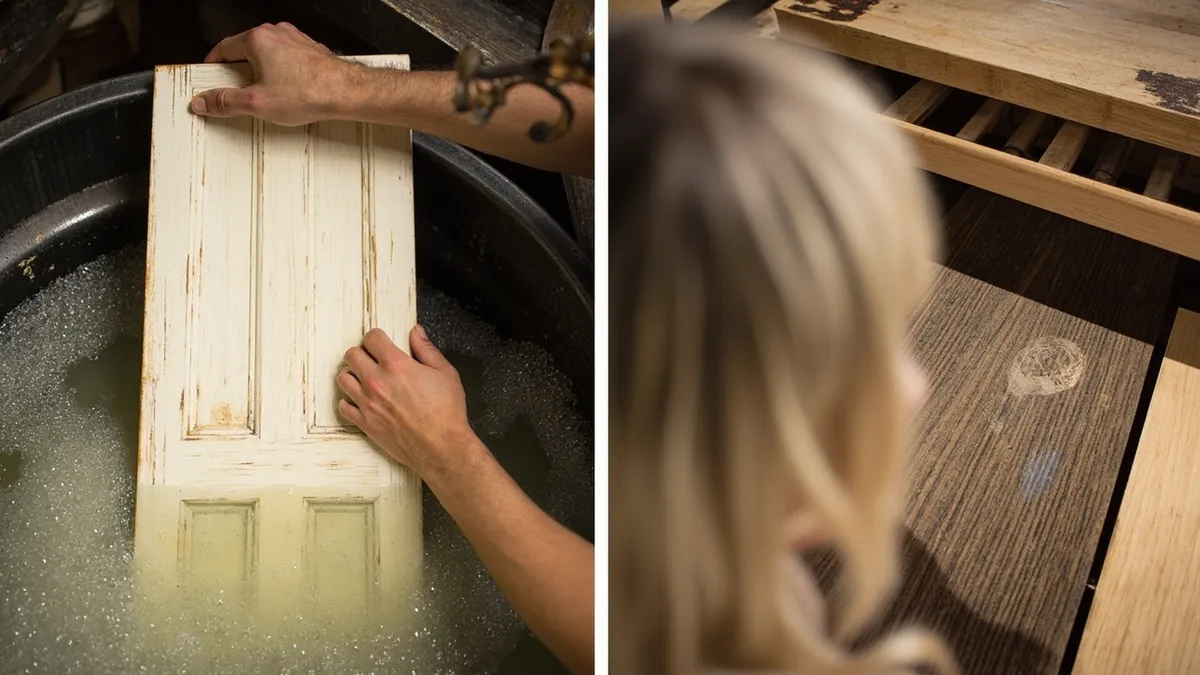
| Factor | Caustic dipping | Hand stripping |
|---|---|---|
| Speed | Fast | Slow and labour-heavy |
| Glued joints | Glue can soften and joints can open | Joints stay dry and sound |
| Grain and surface | Grain can rise, needing more sanding | Surface kept, light finishing only |
| Mouldings | Edges can soften | Profiles kept crisp with shaped scrapers |
| Colour | Timber can darken or grey | Little colour change |
| Residue | Must be fully neutralised | Local, easier to clean off |
| Best suited to | Plain, sound, less important doors | Period, listed or moulded doors |
Should you strip an old door at all?
Often, no. SPAB's view is that stripping old doors is a recent fashion that is usually historically inappropriate and can cause damage. It points out that most old doors are softwood that was originally painted, with the exception of some pre-18th-century oak doors that were sometimes left unpainted (SPAB, Doors).
That matters for the look many people want. Stripped pine doors became fashionable, but the pine in a Victorian door was rarely meant to be seen. It was often chosen to be painted, and it can be knotty and patchy once bare. SPAB also notes that internally it is normally inappropriate to strip paint from softwood joinery, and that earlier decorative schemes hidden under later layers can be destroyed unintentionally (SPAB, Paint).
There are good reasons to strip, though. SPAB accepts that some removal may be warranted where an excessive build-up of paint stops windows working properly or hides architectural details (SPAB, Paint). A door that no longer closes, or whose panel mouldings have vanished under layers of gloss, is a fair case.
Here in Yorkshire we see both sides. Victorian terraces around Huddersfield and the Holme Valley often have front doors buried under decades of paint, while listed and civic buildings in Leeds and Wakefield can have finishes worth keeping. In wet Pennine weather, a sound paint film is what protects an outside door, so stripping one means planning a new finish straight away.
If the building is listed, check before you start. The Planning Portal says listed building consent applies to alterations likely to affect a building's character as a building of special architectural or historic interest, and that it is a criminal offence to do work that needs consent without getting it first (Planning Portal, Listed building consent). Ask your local planning authority or conservation officer. Our guide to listed building consent for timber repairs explains more.
Is old door paint safe to strip?
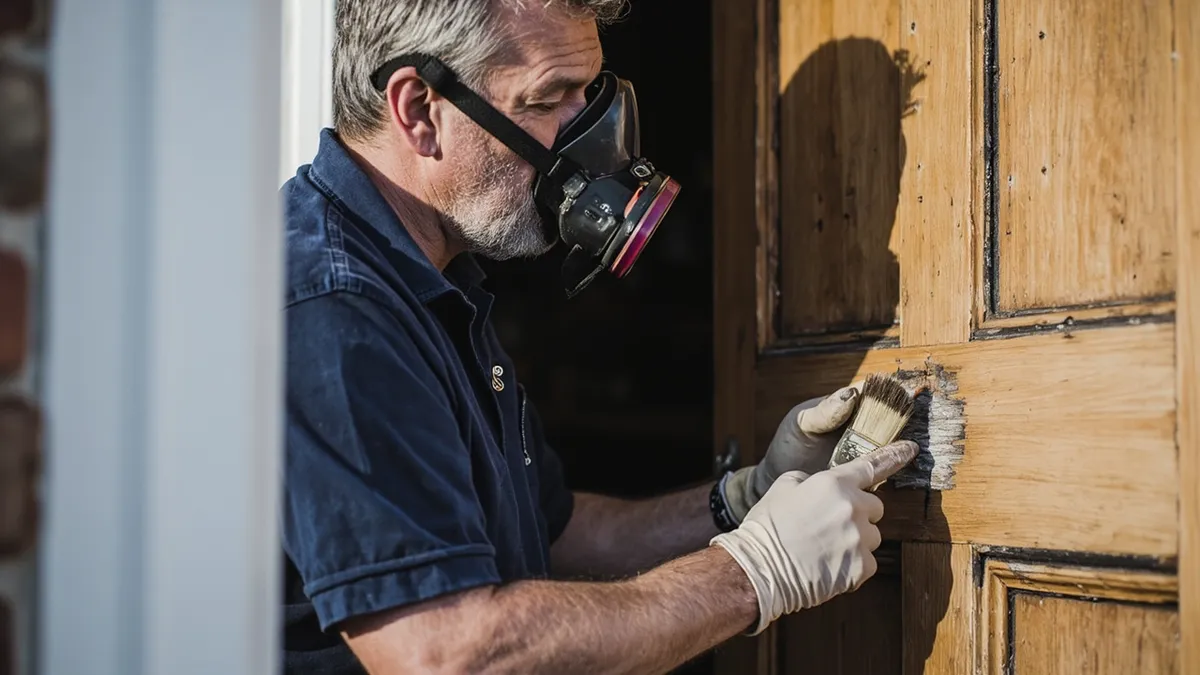
Treat it as lead until you know otherwise. The Health and Safety Executive (HSE) says you are most at risk if you regularly do jobs such as removing existing paint coatings in properties built before the 1980s, stripping old paint with blow lamps or gas torches, and dry sanding old paint. Its advice is to only strip back old paint if it is flaking, chipping or a risk to children, and to remove paint in poor condition with a combination of chemical paint stripper, wet abrasive paper and on-tool extraction (HSE, Frequently asked questions on lead).
SPAB agrees that dust from inappropriate sanding of old lead paint is the greatest hazard, and that the presence of lead paint does not justify stripping out historic joinery. Where lead paint is removed, it recommends wet (not dry) sanding, chemical strippers or low-level heat (SPAB, Lead paint).
Before any door stripping job, run through this checklist:
- Is the paint actually failing, or could it be prepared and repainted?
- Was the house built or decorated before the 1980s? If so, assume lead.
- Is the building listed or in a conservation area? Check with the council first.
- Could there be an early paint scheme underneath worth keeping?
- Is the door softwood made to be painted, or hardwood made to be seen?
- What finish will go on afterwards?
Which is better: a caustic paste or a solvent stripper?
People often compare branded strippers. We don't recommend brands; the real choice is between types. Chemical strippers fall into two broad groups, caustic and solvent (Wikipedia, Paint stripper). Caustic pastes are laid on thickly and can lift several layers at once. Like a dipping tank, they are alkaline, so they can darken timber and must be neutralised thoroughly. Solvent strippers work by swelling the paint so it lets go, and results vary with the paint.
Neither is "better" on every door. We test a small area, then use the mildest method that works. SPAB advises that the most appropriate removal method depends on the type of paint (SPAB, Paint).
How much does it cost to strip a door in the UK?
We can't give a fair single price, because the work varies so much. Hand stripping is priced mainly on time, and the time depends on:
- how many layers of paint there are, and what type;
- how many panels and mouldings the door has, and whether it is glazed;
- whether lead precautions are needed;
- what repairs show up once the door is bare;
- the finish afterwards, from primer and paint to stain and lacquer.
Dipping is faster and can look cheaper, but that price leaves out regluing joints, filling splits and sanding back raised grain if the door comes back damaged. For a sense of what a full door job involves, see our guide to the cost of restoring a Georgian six-panel door. For an honest price, send us photos through our door restoration service page.
Our rule of thumb: strip only what needs stripping
Our workshop rule is simple. If the paint is sound, we recommend preparing and repainting rather than stripping. If the paint has built up so much that the door sticks or the mouldings are lost, we hand-strip. We don't send old, glued, moulded doors for dipping, because a door that comes back with open joints needs more work than it went out with.
A stripped door needs looking after. Our guide to caring for heritage timber covers finishes and maintenance for bare and painted joinery.
Get free advice on stripping and restoring your door
If you are not sure whether your door should be stripped, dipped or simply repainted, ask us first. Master craftsman Daniel Fitzpatrick, a member of the Guild of Master Craftsmen with over 30 years' experience, oversees every job from inspection to installation, and our advice is free.
Call 01484 666 333, send photos through our contact page, or read more about our period door restoration work. We work from Crossley Mills in Honley and cover Holmfirth, Huddersfield, Leeds and the rest of West and North Yorkshire.
Frequently asked questions
What is stripping for doors?
Door stripping is removing old paint, varnish or stain back to bare timber, either by dipping the door in a caustic tank or by softening and scraping the coatings off by hand. It is done to reveal lost detail, free a sticking door or prepare for repair and a new finish.
Does dipping damage doors?
It can. Soaking an assembled door can soften old animal glue, open joints, raise the grain and split panels, and caustic can darken timber. SPAB warns that dipping in acid baths may raise the grain and weaken joints. A plain, sound door may come through well, but older moulded doors carry more risk.
Are stripped pine doors authentic?
Usually not. Most old softwood doors were made to be painted, and SPAB describes stripping them as a recent fashion that is usually historically inappropriate. Pine that was meant to be hidden can look knotty and patchy once bare. Some early oak doors were left unpainted, and those are a different case.
Can I strip a door myself?
You can, but take lead seriously in any house built or decorated before the 1980s. HSE advises against dry sanding and blow lamps, and recommends chemical stripper, wet abrasive paper and on-tool extraction for paint in poor condition. Test a small area first, work slowly and neutralise any stripper residue fully.
Sources
- Society for the Protection of Ancient Buildings: Doors
- Society for the Protection of Ancient Buildings: Paint
- Society for the Protection of Ancient Buildings: Lead paint
- Health and Safety Executive: Frequently asked questions on lead
- Planning Portal: Listed building consent
- Wikipedia: Paint stripper