How to Fix Creaky Stairs in an Old House
By Daniel Fitzpatrick, Master Craftsman · Guild of Master Craftsmen
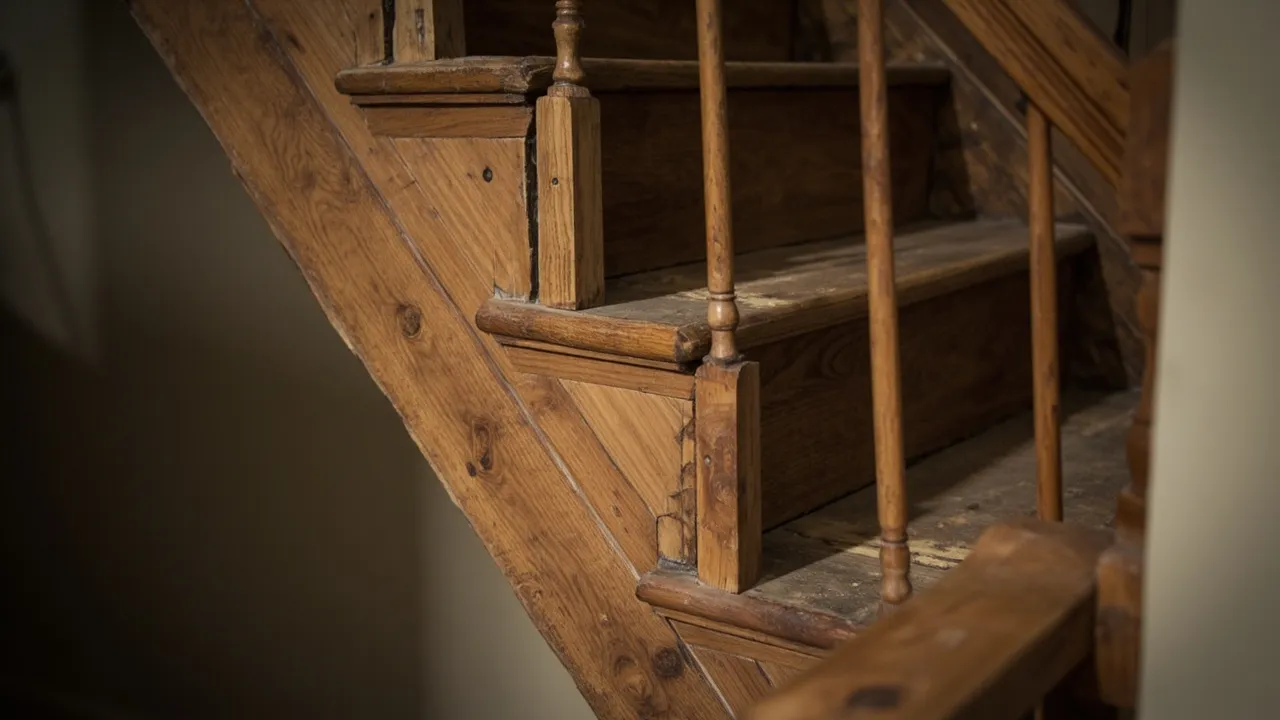
How to fix creaky stairs in an old house: find the step that moves, then stop the timbers rubbing. On period stairs that usually means regluing loose wedges and glue blocks from underneath, or wedging the joints from above if the underside is closed in.
A creaking staircase is a common complaint in period homes across Yorkshire, and on its own it is rarely a sign that the stair is failing. Staircase restoration is part of what we do in our workshop at Crossley Mills in Honley, and on traditional stairs the cause of a creak is usually one of a few loose parts. This guide explains why old stairs creak, how to fix creaky stairs from below and from above, and when it is worth calling in a joiner.
Key takeaways
- Creaks come from loose or flexing timbers rubbing together, usually where a tread meets a riser or where a step is housed into the string.
- On traditional stairs, shrunken wedges and loose triangular glue blocks under the steps are the usual culprits.
- The best fix is from underneath: reglue and drive home the wedges, then reglue or add glue blocks. If the underside is closed in, the joints can be wedged from above.
- Steps that sag, or treads pulling away from the string, point to a bigger problem that needs looking at before any quick fix.
Why do my stairs creak when I walk on them?
Stairs creak when two pieces of timber move against each other under your weight. The Society for the Protection of Ancient Buildings (SPAB) puts it simply: creaking normally occurs when loose or flexing timbers rub together (SPAB, Timber stairs).
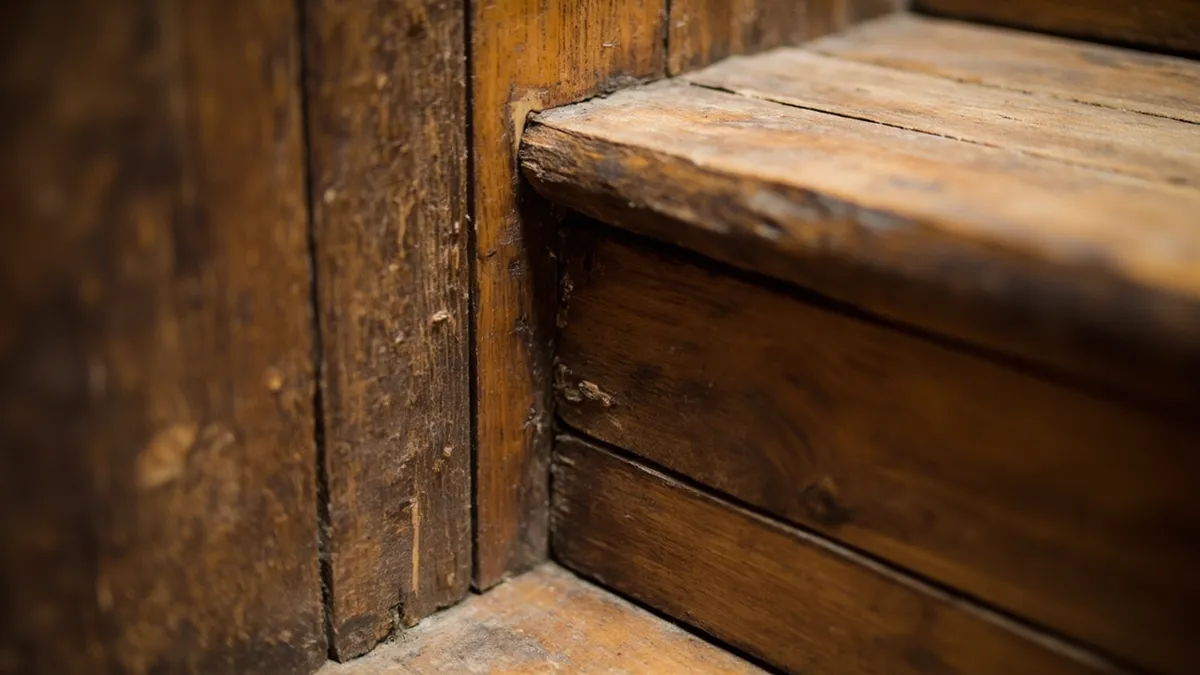
To see where that movement comes from, it helps to know how a traditional stair is built. Each step is made of a tread (the part you stand on) and a riser (the upright board in front of it), and the steps are supported by stringers, or strings (Wikipedia, Stairs). SPAB notes that from the 16th century, framed staircases emerged with boards forming treads and risers that were housed in strings (SPAB).
In a typical Victorian or Georgian stair, the ends of each tread and riser sit in grooves cut into the strings. Tapered timber wedges are glued and driven into those grooves from underneath to lock the steps tight. Small triangular glue blocks are then glued into the angles between the treads and risers. When all of that is tight, the stair is quiet. When any of it works loose, you hear it.
The main reasons those parts work loose over the years:
- Shrinkage. Wood takes in and gives off moisture until it matches the air around it, and it shrinks as its moisture content falls (Wikipedia, Wood drying). It keeps responding to changes in humidity after it is built in, so as a stair dries and moves over the decades, wedges and joints that were once tight can end up slack.
- Failed glue. Glue does not last for ever. On an old stair we often find glue blocks that have dropped off or hang on by one face.
- Wear. Years of footsteps on the same spots loosen nails and joints.
- Past alterations. Plasterboard fixed under a stair, new carpet grippers, or cables run through the steps can all disturb the original fixings.
Is a creaking staircase a sign of something serious?
Usually not. A creak on its own is a noise problem. SPAB says that when defects develop in old stairs, they tend to be in the joints rather than in individual components, and that repair by a skilled carpenter is nearly always viable (SPAB).
It is more serious if the creak comes with movement you can see. SPAB describes occasional cases where treads and risers separate from a string, caused by settlement in a flanking wall, a defective joint at a string end, or differential shrinkage of the staircase timbers. Repair there can mean jacking up the sagging stair and forcing the string back into position, and SPAB is clear that the underlying structural problem must be addressed first (SPAB).
| What you notice | Likely cause | Usual fix |
|---|---|---|
| Creak at the front edge of a tread | Tread rubbing on the top of the riser below | Glue the joint, add glue blocks underneath |
| Creak at one end of a step, near the wall or banister | Loose or shrunken wedge in the string housing | Remove, reglue and drive home the wedge, or cut a new one |
| Tread flexes in the middle | Missing or loose glue blocks | Reglue old blocks and fit new ones |
| Gap opening between the steps and the string | String moving away from the wall or steps pulling out | Structural repair: get the stair looked at first |
| Step dips or bounces badly | Split tread, failed joint or decay | Tread repair or replacement, after checking the cause |
How to find exactly which step is creaking
Before you start, pin down the noise. Most people who ask how to fix creaky stairs are surprised how local the problem is: often one or two steps, and one spot on each.
- Walk up slowly, one foot at a time, and mark any step that creaks with a strip of masking tape.
- On each marked step, stand at the front edge, the back, the wall end and the banister end. Note where the sound is loudest.
- Have someone else walk the stair while you listen from underneath, if there is a cupboard or cellar below it.
- Look under the stair with a torch. Check for wedges standing proud of the string, glue blocks that have dropped off, and daylight between joints.
- Check the string along the wall for any gap opening up, and look for cracks in the plaster where the stair meets the wall.
How to fix creaky stairs from underneath
Working from below is the best way to fix a traditional stair, because you can see the wedges and glue blocks and repair them properly. SPAB's advice sets out the method (SPAB):
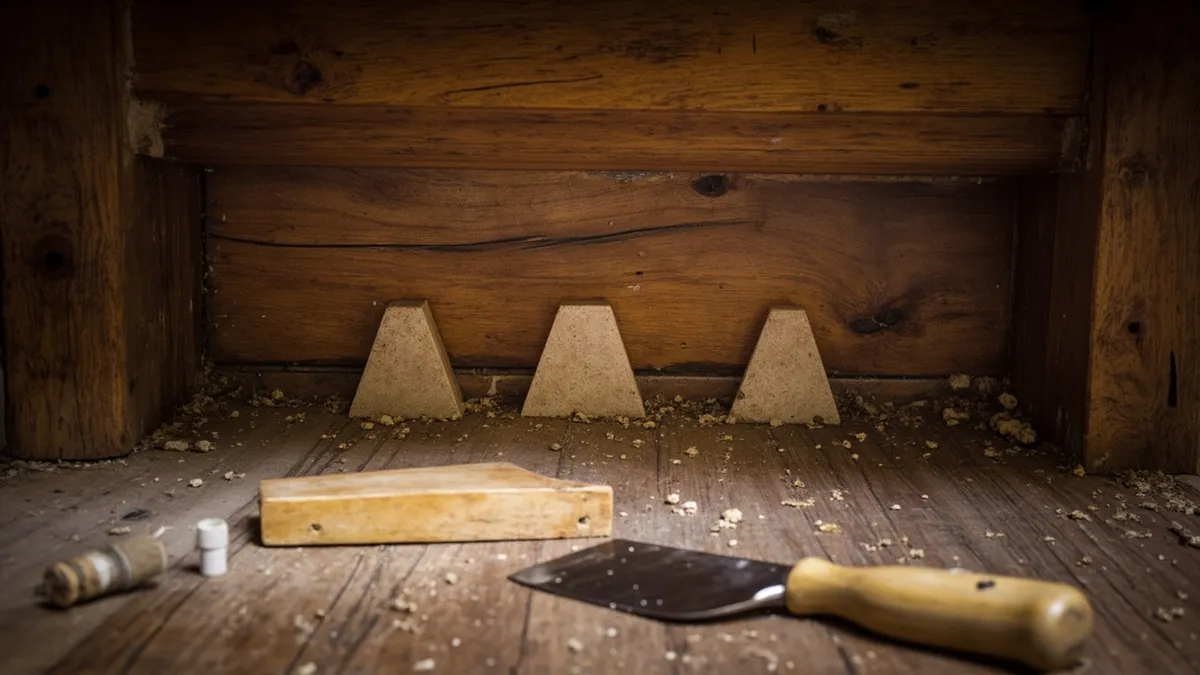
- Work diluted PVA into the tread and riser joints. SPAB suggests PVA diluted 50:50 with water to overcome movement between treads and risers.
- Deal with loose wedges. Remove loose wedges from the tread and riser ends. Clean them and trim them if needed, or cut replacements.
- Glue and drive them home. Apply diluted PVA and drive the wedges firmly back into the housing.
- Refix the glue blocks. Readhere loose triangular glue blocks, or fit new ones where needed, in the angle between tread and riser.
A few practical points from the bench. Scrape off old, crumbly glue before regluing, as fresh glue will not hold well on dust. When you cut new glue blocks, use dry, straight-grained timber and rub them into place so the glue grabs. Keep weight off the repaired steps until the glue has set.
If the underside has been boarded over with plaster or plasterboard, cutting a neat access panel in a cupboard under the stair is sometimes the simplest route. Take care over services, and on a listed building check first (see below).
How do you fix squeaky stairs without removing carpet?
If you can reach the underside, you often do not need to touch the carpet at all. Everything described above happens from below, and it is the neatest way to fix squeaky stairs in a carpeted hallway.
If the underside is closed in, the options are more limited. SPAB says that where the underside of the stair is inaccessible, the joints can be wedged from above (SPAB). That normally means lifting the carpet on the affected steps, because thin glued wedges are worked into the gap where the tread meets the riser or the string and then trimmed flush. For many owners, knowing how to fix creaky stairs from above comes down to this: lift the carpet on one or two steps, not the whole flight.
We are wary of driving screws or nails through a carpet into old treads. It can quieten a creak, but it is easy to split an old tread or its nosing, and fixings that miss the riser just move the noise somewhere else. On a good period stair, or any stair where the treads are to be left bare, we would rather open it up and do the job properly.
What is the best adhesive to fix squeaky stairs?
For wedges, glue blocks and loose tread joints, SPAB's advice uses PVA: diluted 50:50 with water when it is worked into the joints between treads and risers, and diluted PVA on wedges as they are driven home (SPAB).
Avoid expanding foam and gap-filling construction adhesives on period stairs. They are hard to remove and make the next repair much harder. On an important historic staircase, we choose the glue case by case, with a later repair in mind.
Our rule of thumb: when to fix it yourself and when to call a joiner
Our rule of thumb in the workshop is this: if the creak is on one or two steps and you can reach the underside, it is a reasonable job to do yourself with glue, new wedges and glue blocks. We recommend calling a joiner when any of these apply:
- the stair sags, bounces or has a gap opening along the string;
- treads are split, badly worn at the nosing, or show signs of decay or woodworm;
- the underside is plastered and you would need to cut into it;
- the banisters or handrail are loose as well as the steps;
- the house is listed and the stair is original.
SPAB also notes that nosings on softwood treads are particularly vulnerable to damage that leaves them hazardous, and that a defective nosing can be removed along part or all of its length and replaced with well-seasoned matching timber (SPAB). That is bench work, and it is part of our staircase and spindle restoration service. If spindles are loose or missing too, our guide to hand-turned balusters for Victorian staircases explains how we match them.
Creaky stairs in Yorkshire's older houses
Many of the stairs we work on sit in stone-built Victorian terraces and former mill buildings around Huddersfield and the Holme Valley, and in weavers' cottages around Holmfirth, Honley and Marsden. These stairs have had well over a century of footsteps and changing indoor conditions, so shrunken wedges and loose glue blocks are exactly what we expect to find.
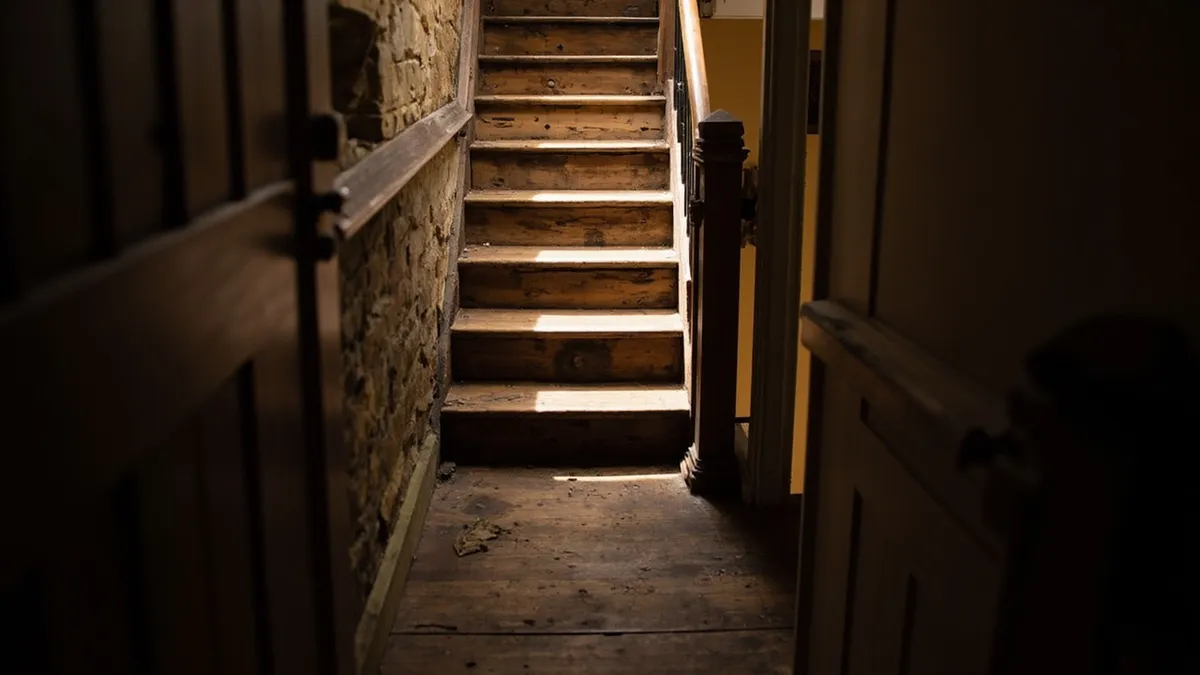
In older terraces the stair often runs between two walls, with a cupboard or cellar steps underneath. That is good news: it usually means the underside can be reached, which makes the repair simpler and keeps the carpet where it is.
If your house is listed, check before you start. The Planning Portal explains that listed building consent applies to any works of alteration likely to affect a building's character as a building of special architectural or historical interest, and that it is a criminal offence to carry out work which needs consent without getting it first (Planning Portal, Listed building consent). Whether a particular job needs consent depends on how it affects the building, so before cutting into a stair, replacing treads or removing original parts, check with your local planning authority or conservation officer. Our guide to listed building consent for timber repairs covers this in more detail.
How much does it cost to fix creaking stairs?
It depends on how many steps creak and how easy they are to reach. A few loose wedges and glue blocks under an open stair is a short job. Stairs with a plastered underside, steps that need new treads or nosings, or a string that has moved from the wall take far longer. For that reason we prefer to see a stair, or at least photos from above and below, before giving a price. Knowing how to fix creaky stairs yourself is useful for the simple cases; for anything more, advice from us is free.
Get free advice on a creaking or worn staircase
If your stairs creak, sag or have loose spindles, we can tell you what is causing it and what it will take to put right. Master craftsman Daniel Fitzpatrick, a member of the Guild of Master Craftsmen with over 30 years' experience as a wood turner and bench joiner, oversees every job from inspection to installation, and there is no charge for advice.
Call 01484 666 333, send us photos through our contact page, or read more about our staircase restoration work. We are based at Crossley Mills in Honley and cover Holmfirth, Huddersfield and towns across West and North Yorkshire.
Frequently asked questions
What is the quickest way to stop creaky stairs?
The quickest lasting fix is from underneath. Find the creaking step, then glue and drive home any loose wedges and reglue or add triangular glue blocks between tread and riser. If you cannot reach the underside, the joints can be wedged from above, which usually means lifting the carpet on the affected steps.
Why do old stairs creak more at some times of year?
Timber takes in and gives off moisture as the humidity around it changes, shrinking as it dries and swelling as it takes up moisture. As the air in a house gets drier or damper through the year, the joints in an old stair can tighten or loosen slightly, so a creak may come and go with the seasons.
Can squeaky stairs be dangerous?
A squeak on its own is usually just noise. It becomes a safety issue if a tread bounces, dips or has a worn or broken nosing, or if the steps are pulling away from the string. In those cases the stair should be checked by a joiner before anyone tries a quick fix.
Do I need permission to repair stairs in a listed building?
Possibly. Listed building consent applies to works of alteration likely to affect a listed building's character, and doing work that needs consent without it is a criminal offence. Whether a stair repair needs consent depends on what it involves, so check with your local planning authority or conservation officer before starting any work.