Woodworm Treatment in Period Homes: Signs and When to Act
By Daniel Fitzpatrick, Master Craftsman · Guild of Master Craftsmen
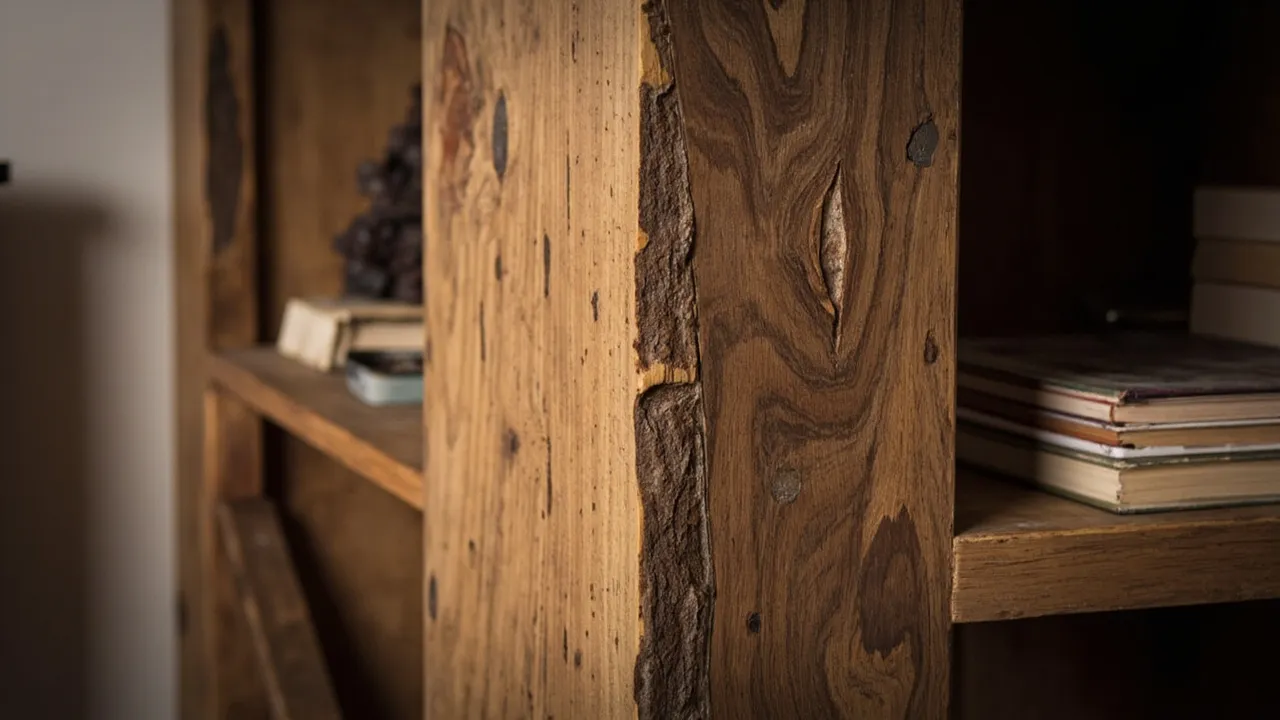
Woodworm treatment is only needed if the beetles are still active. Many flight holes in period homes are decades old and the insects are long gone. Look for sharp-edged, pale holes and fresh bore dust, fix any damp, then treat or repair only the timber affected.
Old houses collect woodworm holes the way they collect paint layers. In our workshop at Crossley Mills in Honley we restore stair treads, doors and furniture from period homes across Yorkshire, and timber of that age often carries old, inactive holes. This guide explains the signs of woodworm, how to tell a live outbreak from old holes, how to get rid of woodworm when it is active, and when damaged timber needs repairing or replacing.
Key takeaways
- Much of the beetle damage found in old buildings is extinct. Establish whether an infestation is active before paying for any woodworm treatment.
- Active holes have sharp edges and pale, fresh-looking insides and dust. Old holes are dark and rounded.
- Woodworm needs damp timber. Drying the building out is the first step in getting rid of woodworm.
- Holes alone are not a reason to replace timber. Replace or splice in new wood only where the timber has lost its strength.
What is woodworm, and why do old houses have it?
Woodworm is the larval stage of wood-boring beetles. The Property Care Association (PCA) describes the term as the generic name for wood-boring insects in their larval stage, most commonly associated with the common furniture beetle (PCA, Woodworm help and guidance for homeowners). SPAB explains that it is the larvae that burrow into the wood. They later pupate, and the adult beetles emerge through flight holes or cracks to mate. Females lay eggs in crevices, maybe old flight holes, and the cycle repeats (SPAB, Wood-boring insects).
In UK buildings, SPAB lists the furniture beetle and the closely related death watch beetle as the main species, with the house longhorn beetle as a more minor insect found in some southern areas.
The key point for period homes is moisture. SPAB states that wood-boring insects, like timber-decaying fungi, only establish themselves where dampness exists, and that beetle damage is usually confined to the sapwood (SPAB). The PCA adds that the insect may have already died out because of the unsuitability of the timber, a drop in the moisture content of the wood, or previous treatments (PCA, Woodworm treatment advice).
What are the signs of woodworm?
The PCA's guide to the signs of woodworm lists three: small round exit holes about 2mm wide that can look like a dart board, fine powdery dust called frass near the holes, and dead beetles in or close to the holes (PCA, Signs of woodworm). It notes that dead beetles may point to a previous, inactive infestation, and that either way it is best to get the timber assessed.
The species matters too. SPAB says furniture beetles attack both softwoods and hardwoods and leave 1–2mm holes with lemon-shaped frass. Death watch beetles favour oak and leave 2–3mm holes with bun-shaped pellets. Smaller death watch outbreaks can be hard to spot, because adults sometimes emerge from cracks instead of holes, but the tapping sound they make in spring during courtship can give them away (SPAB).
How can you tell active woodworm from old damage?
This is the question that decides everything else. SPAB is direct about it: much beetle attack found in old buildings is extinct. Active outbreaks are identified by holes with sharp rather than round edges, with insides and bore dust the colour of freshly cut timber, not dark (SPAB).
| What you see | Points towards | What to do |
|---|---|---|
| Holes with crisp, sharp edges and pale insides | Recent emergence | Monitor, find the damp source, get the timber assessed |
| Holes with rounded, dark, dirty edges | Old, likely extinct attack | Usually no treatment; check the timber is still sound |
| Fresh, pale dust in small piles or trails below holes | Possible activity | Clean the area and see if the dust returns |
| Dark, settled dust in old holes | Old damage, or dust shaken loose by building work | Don't treat on this alone |
| Dead beetles near holes | Could be current or past activity | Get it assessed before deciding |
| Soft, crumbling timber under the holes | Loss of strength, often with damp or decay | Probe it and plan a repair |
Dust can mislead. SPAB warns that active death watch infestation is sometimes wrongly reported in dry timbers when dust is dislodged from old flight holes, perhaps by building work. The PCA also notes that bore dust can be misleading where the environment is left undisturbed (PCA).
If the signs are unclear, monitor for a year:
- Clean away all old dust from the timber and the floor or cill below it.
- Following SPAB's method, cover a group of holes with acid-free tissue paper stuck down with water-soluble glue. Beetles that are present will punch their way out through it (SPAB). SPAB also mentions filling holes with wax polish as an alternative.
- Check through spring and summer. Babergh District Council's heritage guidance notes that adult insects mainly emerge in spring, and suggests cleaning the surface under a suspect area and nearby window sills to record any beetles that collect (Babergh District Council, Wood-boring insects).
- If nothing appears after a full year, the outbreak is likely extinct.
What is the most effective treatment for woodworm?
In a period home, the first woodworm treatment is removing the damp. SPAB's advice is that dry timber is immune to attack, so the first measure is to eliminate all causes of dampness and dry the timber to below about 15% moisture content, for example by controlling condensation (SPAB). The PCA also says the best way to prevent infestation is simply to keep your timbers dry (PCA).
Chemical treatment has a place, but a narrower one than many people are told. SPAB says secondary measures may be needed where infestation is extensive, the timber lacks durability, or moisture is hard to reduce. That could mean targeted chemical treatment, but not as a substitute for drying, and not as a general precaution for extinct outbreaks merely to obtain a guarantee. SPAB also mentions whole-building heat treatment and, in some cases, pheromone or ultraviolet traps. The PCA says active attack can normally be resolved with an approved insecticide, but that timbers should first be investigated to establish if the woodworm is still active to justify any form of treatment (PCA).
For listed buildings, the rules can be stricter. Babergh District Council's guidance says a comprehensive spray treatment there needs listed building consent, that it prefers paste to spray, and that any treatment should be limited to areas of active infestation (Babergh District Council). That is one council's position, so check with your own local planning authority or conservation officer before any woodworm treatment on a listed home. Our guide to listed building consent for timber repairs explains how consent works for joinery.
Why woodworm turns up in Yorkshire period homes
Here in Yorkshire, the conditions woodworm likes are easy to find. Stone-built Victorian terraces and mill buildings around Huddersfield and the Holme Valley sit in wet, exposed Pennine weather. The weavers' cottages around Holmfirth, Honley and Marsden have floor timbers and joist ends bedded into thick stone walls. Where those walls stay damp, so does the timber touching them.
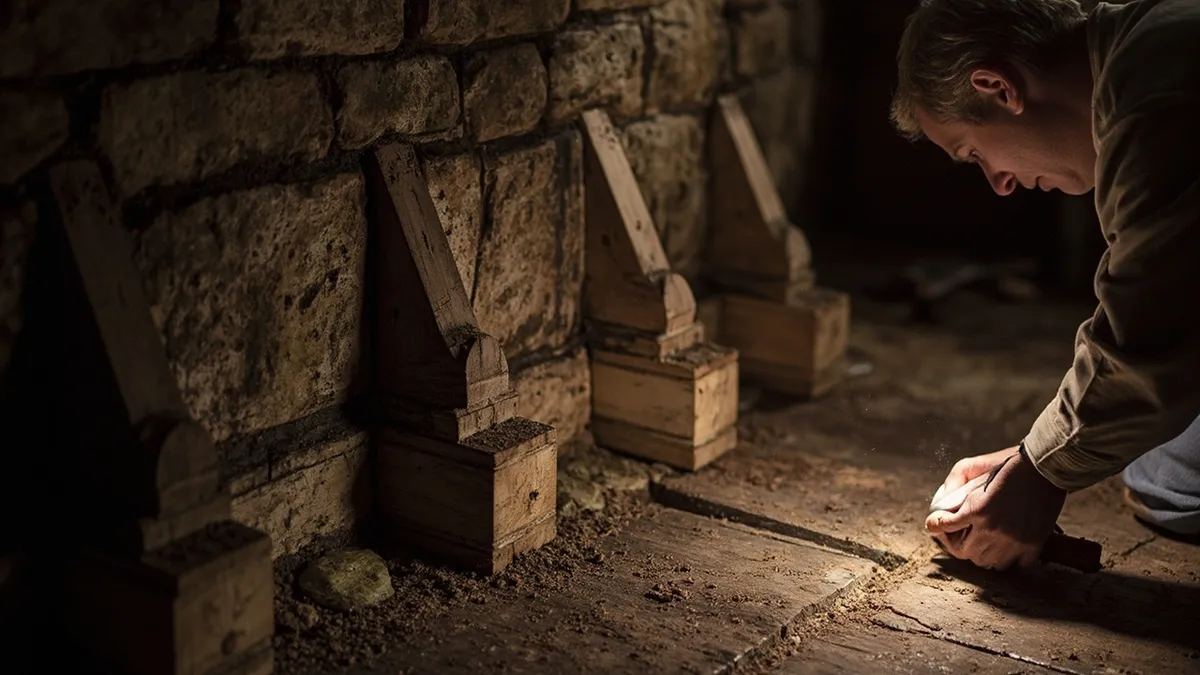
Babergh District Council's guidance points to impermeable finishes, such as cement render or modern paints, as the most common cause of damp in old buildings, and says an infestation may persist until they are replaced with breathable alternatives. It also names roof leaks and condensation under old roofing felt as causes of beetle attack in roofs (Babergh District Council). So in a period house, look first at cellars, ground-floor boards over damp voids, joist ends in outside walls, and roof timbers.
Can I do woodworm treatment myself?
You can, but think carefully first. The PCA says you can potentially treat timber yourself with insecticide bought from a DIY store, but you will have to be extremely careful and suitably protected, paying attention to undersides and hard-to-reach surfaces (PCA). It also says the most effective time to apply insecticide is from early spring to late summer, when adults emerge.
Before you buy anything, do the things that cost little and help most: confirm the outbreak is active, find and fix the damp, and improve ventilation. If you want a second opinion, SPAB advises that advice should come from an independent chartered surveyor or consultant, not a remedial treatment contractor (SPAB). Don't cut or sand away beetle-damaged surfaces either. SPAB warns that degraded surface timber is still removed without good reason, and that serious mutilation can result.
Woodworm in furniture: what to do
The same rules apply to woodworm in furniture. Check whether the holes are fresh, look for pale dust on the floor under legs and drawers, and keep the piece in a dry, heated room. The PCA notes that treatment, where it is justified, applies to infested timber whether in furniture or in buildings (PCA).
Old furniture often has holes that are decades old, and they are part of its history. Where beetles have weakened a chair leg, a drawer runner or a table rail, we can repair or remake the part at the bench. Our furniture restoration service covers this kind of structural repair.
When does woodworm-damaged timber need replacing? Our rule of thumb
SPAB advises that major damage may call for conservative timber repairs, but warns against automatic wholesale replacement (SPAB). The PCA says that where the attack is so severe that the strength of the timber is affected, it may be necessary to replace the infested parts with new timber, treated before use (PCA).
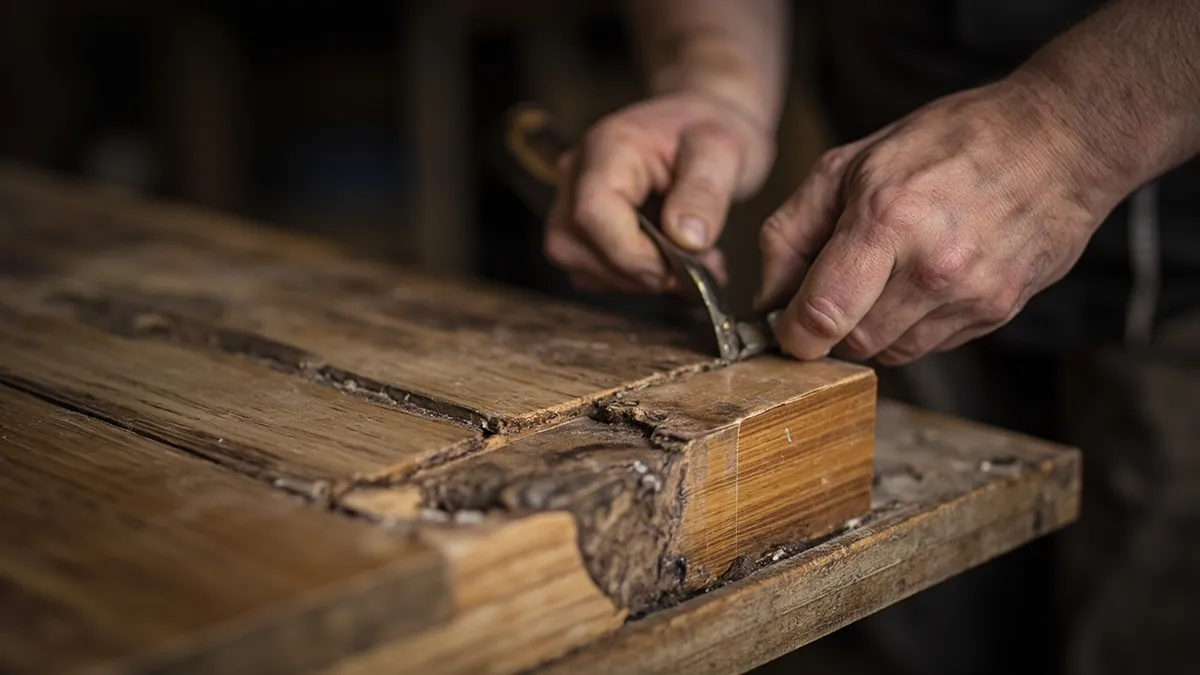
Our rule of thumb in the workshop: we judge the timber by its strength, not by its holes. If a probe meets firm wood just under a riddled surface, we leave it alone. If the probe sinks in, the wood crumbles, or a tread, rail or stile flexes under load, we cut back to sound timber and splice in new wood matched to the original. We replace a whole component only when the weakness runs through it.
Our conservation joinery work is built around this approach: keep every piece of original timber that can still do its job. For staircases, see our staircase and spindle restoration service.
Can I sell a house with woodworm?
Old woodworm holes are common in period houses, and they often come up in a buyer's survey. What matters is whether the attack is active and whether the timber is still sound. SPAB notes that sound timbers and old woodworm holes are sprayed unnecessarily when a building changes hands (SPAB). The PCA, for its part, notes that professional contractors can offer treatment with a long-term guarantee, which some people want for peace of mind when buying or selling (PCA).
If woodworm is raised during a sale, get an independent assessment of whether it is active, keep any evidence of monitoring, and talk to your surveyor and conveyancer about what the buyer needs. Our guide to caring for heritage timber covers the routine checks that help keep old timber dry and sound.
Worried about woodworm damage? Get free advice
If you have woodworm holes in floorboards, stairs, doors or furniture and want to know whether the timber can be saved, we can take a look. Master craftsman Daniel Fitzpatrick, a Guild of Master Craftsmen member with over 30 years at the bench, oversees every job himself, and there is no charge for advice.
Call 01484 666 333, get in touch through our contact page, or read more about our conservation joinery and timber repair service. We work from Crossley Mills in Honley and cover Holmfirth, Huddersfield and other Yorkshire towns including Leeds, Wakefield, Harrogate and York.
Frequently asked questions
Does vinegar kill woodworm?
We know of no conservation or industry guidance that recommends vinegar. The PCA doubts that even insecticide brushed or sprayed on the surface kills older death watch larvae working deep in the timber. The measure SPAB puts first is drying the timber out, because dry timber is immune to attack.
How do I get rid of woodworm for good?
Find and fix the source of damp, dry the timber and keep it ventilated. SPAB says dry timber is immune to attack. Confirm the outbreak is active before any treatment, limit treatment to affected timber, and repair only the parts that have lost strength. Then check the area each spring and summer.
Is woodworm in a period home serious?
It can be, but often it is not. SPAB says much beetle attack in old buildings is extinct. An active outbreak in damp timber can weaken joists, treads and roof timbers over time, so it is worth confirming. Old, dark, rounded holes in firm timber usually need no treatment at all.
Can woodworm spread from furniture to the house?
Adult beetles emerge from the timber and females lay eggs in crevices and old flight holes, so an active outbreak could reach nearby timber. They only establish themselves where dampness exists, though. Keep an affected piece in a dry, heated room, away from other furniture, and check for fresh dust before bringing it back.
Sources
- Society for the Protection of Ancient Buildings: Wood-boring insects
- Property Care Association: Woodworm help and guidance for homeowners
- Property Care Association: Signs of woodworm
- Property Care Association: Woodworm treatment advice
- Property Care Association: Woodworm beetles
- Babergh District Council: Wood-boring insects