How to Replace Stair Spindles on a Period Staircase
By Daniel Fitzpatrick, Master Craftsman · Guild of Master Craftsmen
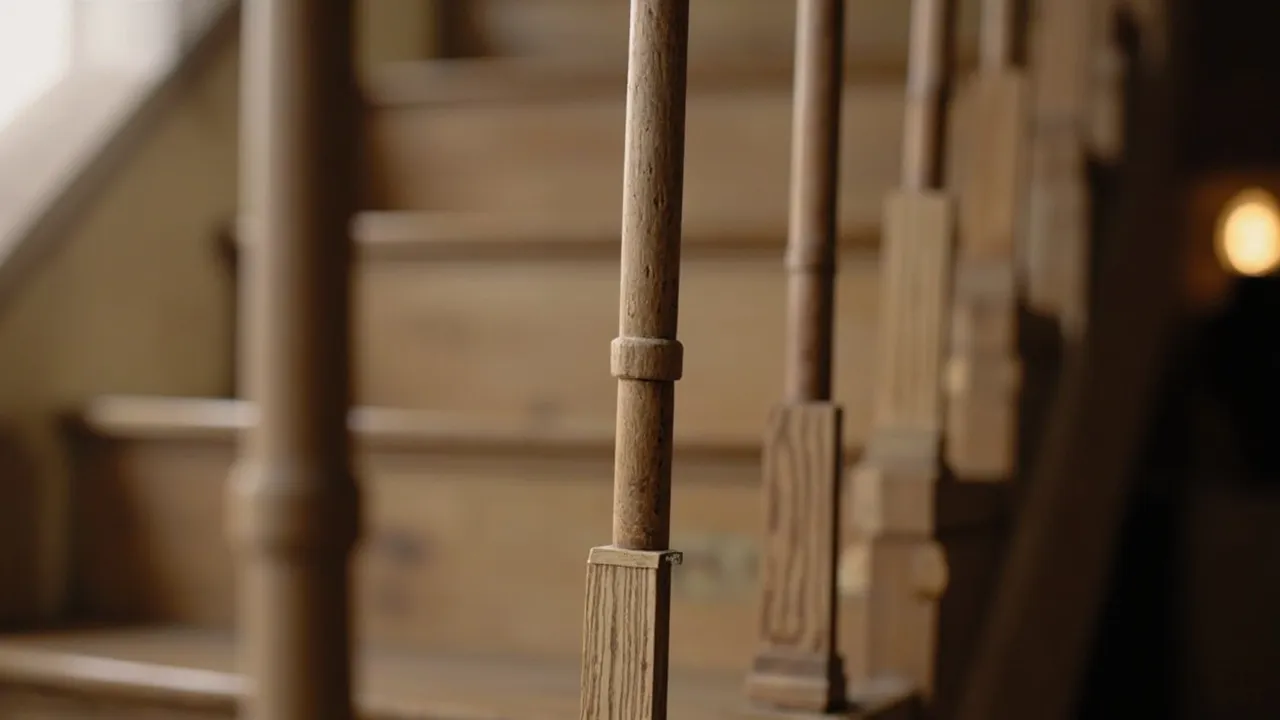
How to replace stair spindles on a period staircase: measure an original, turn a copy to the same profile, cut the broken one out without splitting the handrail or string, then fix the new spindle into the same housings with glue and a small pin.
That is the short version. We turn replacement spindles on the lathe in our workshop at Crossley Mills in Honley and fit them on period staircases across Yorkshire. This guide explains how we measure, copy and fix them, and when the job is one to do yourself.
Key takeaways
- Replacing banister spindles one or two at a time is usually possible without taking the handrail off, as long as you cut the old spindle out rather than force it.
- A replacement only looks right if it copies the original's length, square sections and turned profile. Take the pattern from a sound spindle on the same flight.
- On many stairs each tread carries two balusters of different lengths, so measure every position you are replacing, not just one.
- Replacing a whole balustrade is a bigger job. In a listed building it may need consent, and building regulations guidance on guarding may apply, so check with your local planning authority or conservation officer before you start.
How to replace stair spindles: what does the job involve?
A spindle, or baluster, is one of the upright pieces that holds up the handrail. Wikipedia describes a baluster as an upright support, often lathe-turned, found in stairways, and notes that in furniture the same part is called a spindle. The word banister can mean a single baluster or the whole run of balusters and handrail (Wikipedia, Baluster).
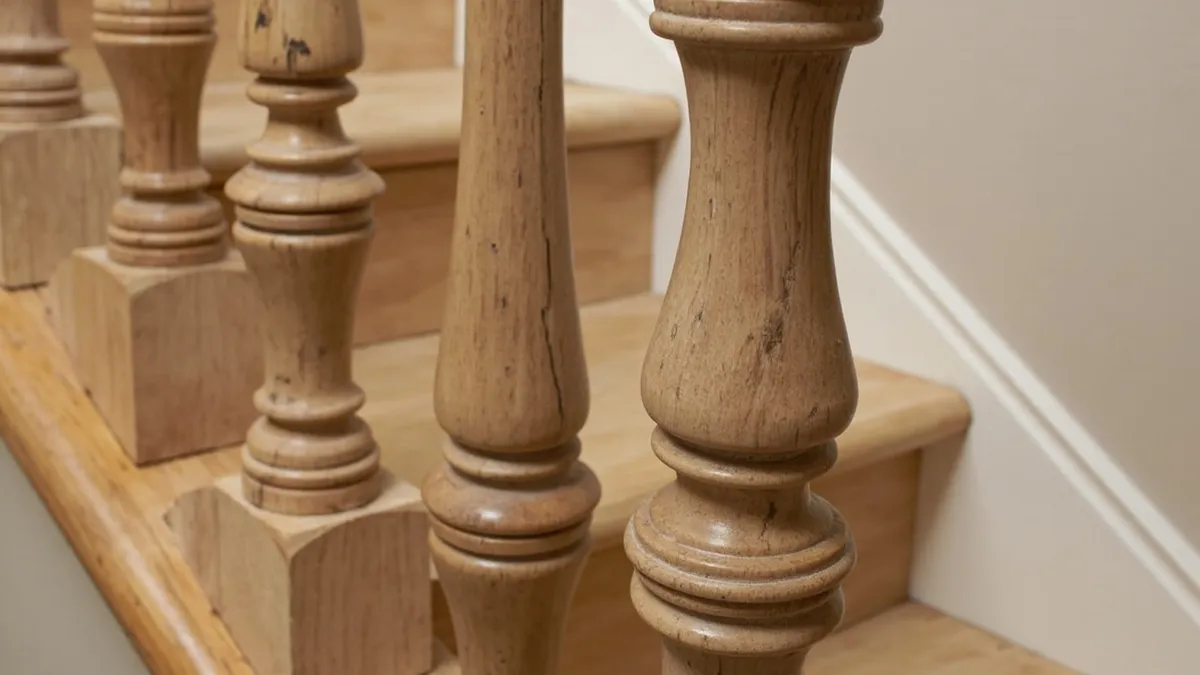
Knowing how to replace stair spindles comes down to four stages:
- Survey. Find out how the spindles are fixed at the top and bottom, and whether the handrail, newels and string are sound.
- Measure and copy. Take the length, the size of the square sections and the turned profile from a good original.
- Remove. Take out the broken or missing spindle without damaging the handrail, the tread or the string.
- Fit. Cut the new spindle to length, fit it into the old housings, glue and pin it, then finish it to match.
Our staircase and spindle restoration work follows the same order whether we are replacing one snapped spindle or a whole run.
Is it easy to replace staircase spindles?
It depends on two things: how the spindles are fixed, and whether you can get a matching spindle. Plain square spindles on a modern stair are a manageable job for a careful DIYer. Turned Victorian staircase spindles are harder, because a stock spindle rarely matches the original profile, and the fixings are often hidden.
| Situation | How hard is it? | What usually decides it |
|---|---|---|
| One loose spindle, still sound | Easy | Clean out the old glue, re-glue and pin. No new spindle needed. |
| One broken plain square spindle | Fairly easy | Cutting the old one out cleanly and matching the angle at the handrail. |
| One broken turned spindle on a period stair | Moderate | Getting a copy turned to the original profile and length. |
| Several spindles missing or mismatched | Moderate to hard | Measuring every position and turning a matched set. |
| Loose handrail or newel as well as broken spindles | Hard | The handrail and newels must be made sound first, or new spindles will work loose. |
So is it hard to replace spindles? Removal and fitting are mostly patience. The hard part on an old stair is the copy: a spindle slightly too thick, or with a bead in the wrong place, stands out.
How do you remove stair spindles?
First work out how they are fixed. On period stairs the top of each spindle normally sits in a shallow housing or mortice in the underside of the handrail, held with glue and sometimes a small nail. The bottom is fixed in one of two ways:
- Closed string. The spindles stand on a capping along the top of the string, often with small fillet pieces between them.
- Cut string. The string is cut to the shape of the steps and the spindles stand on the treads, often housed into the end of each tread behind a return nosing. Wikipedia notes that stringers on open-sided stairs are called cut stringers (Wikipedia, Stairs).
Then take the spindle out carefully:
- Protect the treads and floor with dust sheets.
- Look for pins at the top and bottom. A magnet run over the wood will often find them.
- Cut through the spindle near the middle with a fine saw. Do not lever the whole spindle sideways, because that splits the handrail housing.
- Work each half loose by twisting it gently.
- If a stub is stuck in its housing, pare it out with a sharp chisel, working towards the centre of the hole.
- Pull or cut off any old nails, and clean old glue and dirt out of both housings.
How to replace stair spindles without removing the banister
This is a common question, and on most period stairs the answer is yes, you can. Here is how to replace stair spindles one at a time while the handrail stays in place:
- Cut the new spindle slightly over length, with the square sections left full.
- Offer it up and mark the top at the angle of the handrail. A sliding bevel set from the old spindle gives you the angle.
- Cut the top to the angle, then trim the bottom until the spindle springs into place with light pressure.
- Where the bottom sits in a housing in a tread, angle the spindle in at the top first, then swing the bottom into its housing.
- Where the bottom stands on a closed string, fit the spindle, then refit the fillets on each side to hold it.
- Glue both ends and fix each end with a small pin driven at an angle, pre-drilled so the end does not split.
If several neighbouring spindles are missing or the handrail has dropped, we sometimes ease the handrail off, but only when its own joints need repair anyway.
How do you match a Victorian staircase spindle?
Copying an existing spindle is everyday work at our lathe, and it is the step that decides how to replace stair spindles so nobody can spot the new one. We cover the difference hand turning makes in our guide to hand-turned balusters for a Victorian staircase.
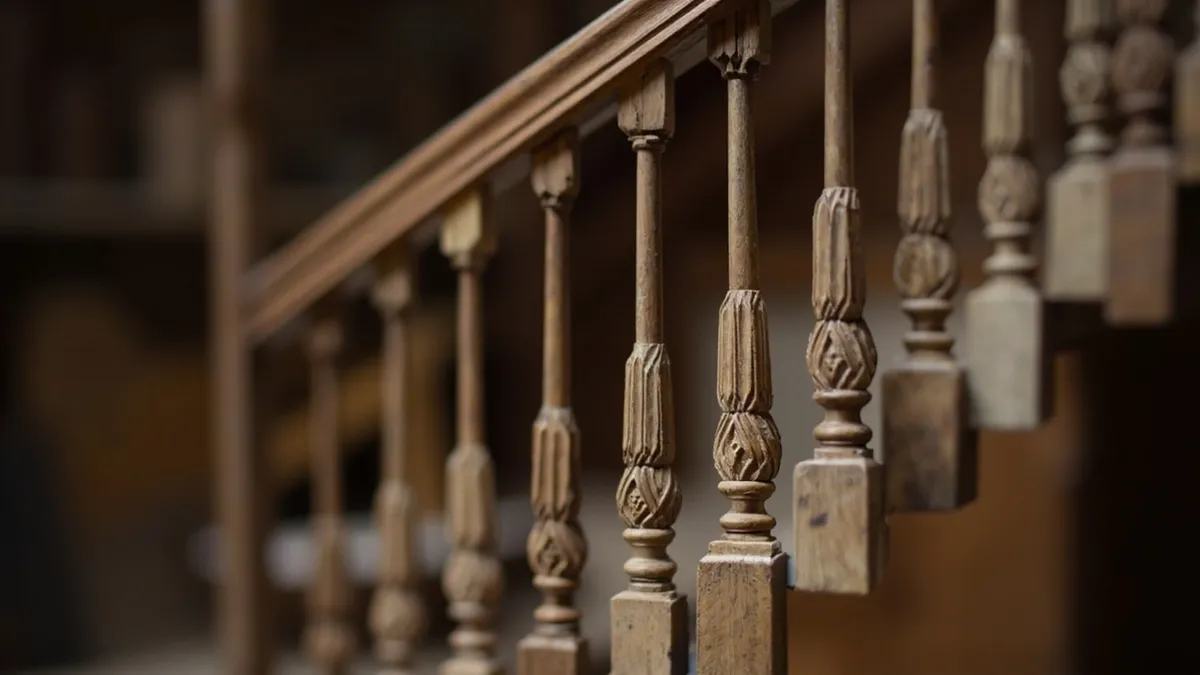
What to measure
- Overall length of each spindle you are replacing, including the part hidden in the housings.
- The square sections at the top and bottom, measured across the flats.
- The turned section: the position and diameter of every bead, cove and taper, measured from one end.
- The handrail angle at the top, and whether the bottom is cut square or at an angle.
- The timber, which tells you what the copy should be made from.
Measure each position. On many stairs each tread carries two balusters, and Wikipedia's staircase article notes that the second one, closer to the riser, is taller than the first (Wikipedia, Stairs). A spindle copied from the wrong position will be too short or too long.
How we copy the profile
We take the best surviving original, not a broken one, and lift the profile onto a card or thin board template. On the lathe the blank is turned to the largest diameter first, then each detail is marked from the template and sized with callipers. For a run of matching spindles we make a storey stick so every copy has its details in the same place.
Choosing the timber
Match the original species. For a varnished or polished stair the copy also needs matching colour and grain, so we often use reclaimed timber; where new timber is needed we use FSC-certified stock. Our woodturning service covers one-off copies and full matched sets.
How are new spindles fixed into the string and handrail?
Copy the original fixing. The table shows the usual arrangements on period stairs and how we fit each.
| Fixing point | How the original is usually held | How we fit the replacement |
|---|---|---|
| Underside of the handrail | Shallow housing or mortice, glue, sometimes a pin | Clean the housing, fit the spindle snug, glue and pin at an angle |
| Closed string with capping | Housing or groove in the capping, with fillets between spindles | Fit the spindle, then glue and pin the fillets back each side |
| Cut string, into the tread | Housing in the tread end, often covered by a return nosing | Remove the return nosing if needed, fit the spindle, refit the nosing |
| Base rail | Housing or groove in a rail, much like a closed string | As for a closed string |
A few points apply to every fixing:
- The spindle should be a snug push fit. If it is loose in the housing, glue alone will not hold it.
- Pre-drill for pins in old, dry timber. Handrails split easily near the end grain of a housing.
- Keep the spindle plumb, checked with a level on two faces.
- Avoid large screws through the handrail. They split old timber and are hard to hide.
When should a spindle be repaired rather than replaced?
Our rule of thumb in the workshop: if the original spindle is in one piece, or broken with a long, clean split, we glue and clamp it and put it back. We only turn a new spindle when the old one is missing, shattered, badly wormed or has already been replaced with one that does not match. An original spindle, even one that has been repaired, keeps the stair's history, and it is already the right length and profile.
This is common in older Yorkshire houses. Victorian terraces around Huddersfield and the Holme Valley, and spa-town villas in Harrogate, often have stairs where a few spindles were replaced over the decades with whatever was to hand. Putting the stair back to a matched set is usually a case of turning a handful of copies, not replacing the whole balustrade. See our page on heritage joinery in Huddersfield.
Before you start, check:
- Is the handrail firm when you push it sideways?
- Are the newel posts solid at the foot and the top of the flight?
- Are the housings in the handrail and string sound, or split and chewed?
- Is there any active woodworm in the spindles or string?
- Do you have at least one good original to copy?
Do you need permission or regulations approval?
A like-for-like repair of one or two spindles in an unlisted house is usually simple. Two situations need more care.
Listed buildings. The Planning (Listed Buildings and Conservation Areas) Act 1990 says no one may carry out works to alter a listed building in any way that would affect its character as a building of special architectural or historic interest unless the works are authorised (Planning (Listed Buildings and Conservation Areas) Act 1990, section 7). Replacing a whole balustrade, or changing the spindle design, could affect character. Check with your local planning authority or conservation officer first. Our guide to listed building consent for timber repairs explains more.
Building regulations guidance. Paragraph 1.39 of Approved Document K, the statutory guidance for England, says: "In a building that may be used by children under five years of age, construct the guarding to a flight of stairs to do both of the following. a. Prevent children being held fast by the guarding: ensure that a 100mm sphere cannot pass through any openings in the guarding. b. Prevent children from readily being able to climb the guarding." (Approved Document K). Many period staircases were built long before this guidance. If you are replacing a whole balustrade rather than a single spindle, ask your building control body how the guidance applies to your stair, and in a listed building also check with your local planning authority or conservation officer.
Get free advice on replacing stair spindles
If you have broken, missing or mismatched spindles on a period staircase, send us a photo of a good original and of the damaged ones. Master craftsman Daniel Fitzpatrick, who has over 30 years' experience in woodturning and bench joinery and is a member of the Guild of Master Craftsmen, oversees every job from inspection to installation. Advice is free.
Call 01484 666 333, get in touch through our contact page, or read more about our staircase restoration service. We work from Crossley Mills in Honley and cover Holmfirth, Huddersfield and other towns across West and North Yorkshire.
Frequently asked questions
Can I replace one stair spindle on its own?
Yes. Replacing banister spindles one at a time is the usual approach on a period stair. Cut the old one out, clean the housings in the handrail and string, and fit a copy turned to the same profile and length. The handrail can normally stay in place if it is sound.
How do you fix a loose stair spindle?
Ease it out if you can, scrape out the old glue and dirt from both housings, then re-glue it and fix it with a small pre-drilled pin at each end. If it is loose because the housing has split or worn, the housing needs repair first, or the spindle will work loose again.
What wood should replacement spindles be made from?
Match the original. Painted stairs were often softwood, while stairs meant to be seen were often mahogany or oak. For a varnished or polished stair, reclaimed timber of the same species usually gives the closest match in colour and grain. For a painted stair, the profile matters more than the timber.