Oak Veneer Door vs Solid Oak: How to Tell
By Daniel Fitzpatrick, Master Craftsman · Guild of Master Craftsmen
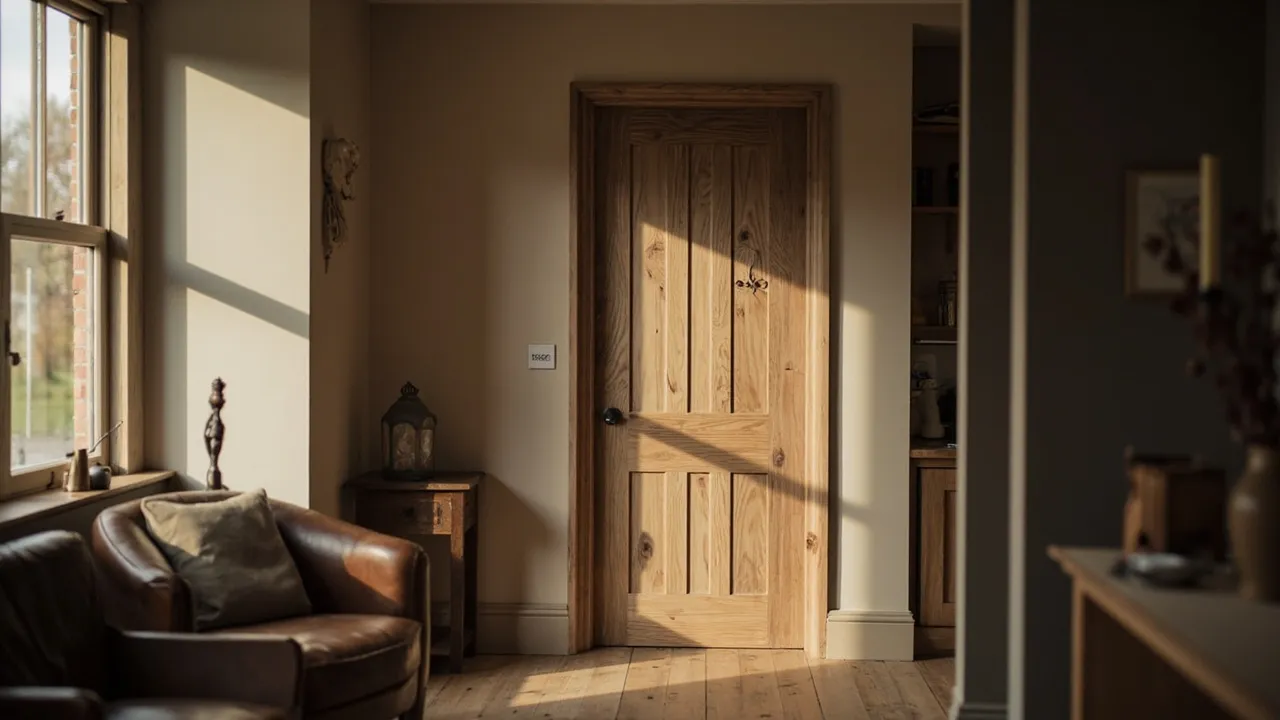
An oak veneer door has a thin slice of real oak glued over a core of cheaper timber or board, while a solid oak door is oak all the way through. Check the end grain, edges, weight and grain pattern to tell which one you have.
We get asked this question often by owners of period homes across Yorkshire, usually when a door needs sanding, repairing or matching. In our workshop at Crossley Mills in Honley we work on both kinds. This guide explains how to tell them apart, how each one ages, and what can be repaired or refinished.
Key takeaways
- Veneer is a thin layer of real wood glued to a core panel. It looks like oak on the surface but is not oak throughout.
- The quickest tests are the top or bottom edge, the grain on the edges, the weight and whether the grain pattern repeats.
- An oak veneer door can be refinished, but only with very light sanding. Sand through the veneer and the repair becomes difficult.
- A solid oak door can be planed, stripped, spliced and refinished many times, which is why it suits a period home.
What does oak veneer mean?
Veneer is defined on Wikipedia as a thin slice of wood that is typically glued onto a core panel, usually wood, particle board or medium-density fibreboard, to make flat panels such as doors (Wikipedia, Wood veneer). So what does oak veneer mean in practice? The face you see and touch is real oak, but underneath is a different material.
The same source says veneers can be cut as thin as 0.64 mm, and that historically they were sawn in layers of about 3 mm (Wikipedia). That thickness is what decides how much sanding and repair a veneered door can take.
Veneering is not a cheap modern trick. Wikipedia notes it goes back at least to the ancient Egyptians, who used expensive veneers over cheaper timber. Fine period furniture is often veneered too; our guide to restoring antique furniture covers that side. An oak veneer internal door from recent decades, though, is usually veneer over an engineered core.
How can you tell if a door is solid oak or veneer?
Use this checklist. No single sign is conclusive, but three or four together usually are.
- Look at the top or bottom edge. Take the door off or use a mirror. On a solid oak door you see the end grain of the stiles and the edge of the rails as continuous oak. On a veneered door you may see a thin line of oak over a lighter or uniform core, or a separate edging strip.
- Follow the grain round the edge. On solid timber the figure on the face carries on round the corner onto the edge. On veneer the face and edge grain often do not match, because the edge is a separate lipping.
- Check the panels. Solid oak panels sit loose in grooves and may show a fine shrinkage line at the edge. Flat, perfectly stable panels with no movement line are more often veneered board.
- Feel the weight. Solid oak is heavy. A door that feels light for its size probably has a lighter core, though some engineered cores are dense too.
- Look for a repeating pattern. Veneer leaves are kept in the order they are cut, so neighbouring panels can show nearly identical, mirrored figure. Solid boards each have their own grain.
- Look at the joints. A traditional solid door has visible mortise and tenon joints where rails meet stiles. A veneered face may run across the joint line without a break.
- Check chips and damage. A chipped corner or a hinge recess can show the core material directly.
| Test | Solid oak door | Oak veneer door |
|---|---|---|
| Top and bottom edge | Oak end grain right through | Thin oak skin over a different core |
| Grain round edges | Continues from face to edge | Often breaks at a lipping |
| Weight | Heavy | Usually lighter, varies with core |
| Grain pattern | Each piece different | Can repeat or mirror between panels |
| Joints | Visible joint lines between rails and stiles | Face may cover the joints |
| Panels | Solid, can move in grooves | Usually flat and stable |
What are the disadvantages of veneer doors?
The main drawbacks of a veneer door all come from that thin surface:
- Little room for sanding. There is only so much oak to work with. Deep scratches, dents and burns cannot simply be sanded out.
- Lifting and blistering. Water, heat or a failed glue line can make veneer lift or bubble, especially at the bottom of a door near a damp floor.
- Edge damage. Edges and corners take knocks. Once a lipping or veneer edge chips, the core shows.
- Little room for trimming. Planing a door to fit can cut into the core. Cutting the bottom down to clear a new floor may expose it too.
- Harder repairs. Patches have to match colour and figure in a very thin layer, which is skilled work.
Veneer has advantages as well. A veneered door is usually more stable than solid timber, so it is less likely to warp or show panel shrinkage, and it uses far less oak.
Can you sand an oak veneer door?
Yes, carefully. Sand by hand or with a fine sander, with fine grit, along the grain, and stop as soon as the finish is cleaned off. Keep away from edges and corners, where veneer wears through first. Never use a coarse belt sander.
For a door with old varnish, we usually prefer a gentle chemical strip followed by the lightest possible sanding, so very little oak is removed. Avoid soaking the door with water-based strippers or steam; moisture can loosen the glue. Dipping a veneered door in a tank is not suitable. For more on stripping methods, see our article on dipping vs hand stripping doors.
What about repairs?
Small chips can be filled with a coloured wax or patched with a matching piece of veneer. Lifted veneer can often be re-glued and pressed flat. Where a large area has worn through, re-veneering a whole panel or stile may be possible, but sometimes a new door is the more sensible answer.
How do solid oak and veneer doors behave over time?
A solid oak door moves with the seasons. Panels shrink and swell in their grooves, and joints can loosen after many decades. But it can be taken apart, re-glued, planed, stripped and spliced, then refinished again and again. Old oak doors in churches and halls are proof of how long that can go on; our guide to restoring church oak doors shows what is involved.
An oak veneer door stays flat and stable, but its life is tied to the glue line and that thin face. Kept dry and treated gently, it can last well. Once the veneer is badly worn or water-damaged, repair options narrow quickly.
| Over time | Solid oak | Oak veneer |
|---|---|---|
| Movement | Seasonal movement, panels may shrink | More stable |
| Refinishing | Can be sanded and stripped many times | Light refinishing only |
| Damage repair | Splices and new sections possible | Patches in thin veneer, harder to hide |
| Water damage | Can stain or rot but is repairable | Veneer can lift or delaminate |
Is a solid oak door worth it for a period home in Yorkshire?
Wikipedia describes oak timber as strong and hard, used for furniture, floors, building frames and veneers (Wikipedia, Oak). In older houses that matters because doors are expected to be repaired, not thrown away.
Many period houses in Yorkshire, from weavers' cottages around Holmfirth to listed Georgian buildings in York, had painted softwood doors, not oak. In those houses a solid oak door is not necessarily the "correct" choice. Where oak suits the building, for example in a stone farmhouse, a church hall or a house with existing oak joinery, a solid oak door will match the character and can be repaired like the rest of the building. In damp Pennine houses with solid stone walls, a door that can be eased and rehung is useful.
Our rule of thumb: repair, refinish or replace?
We recommend this approach in the workshop:
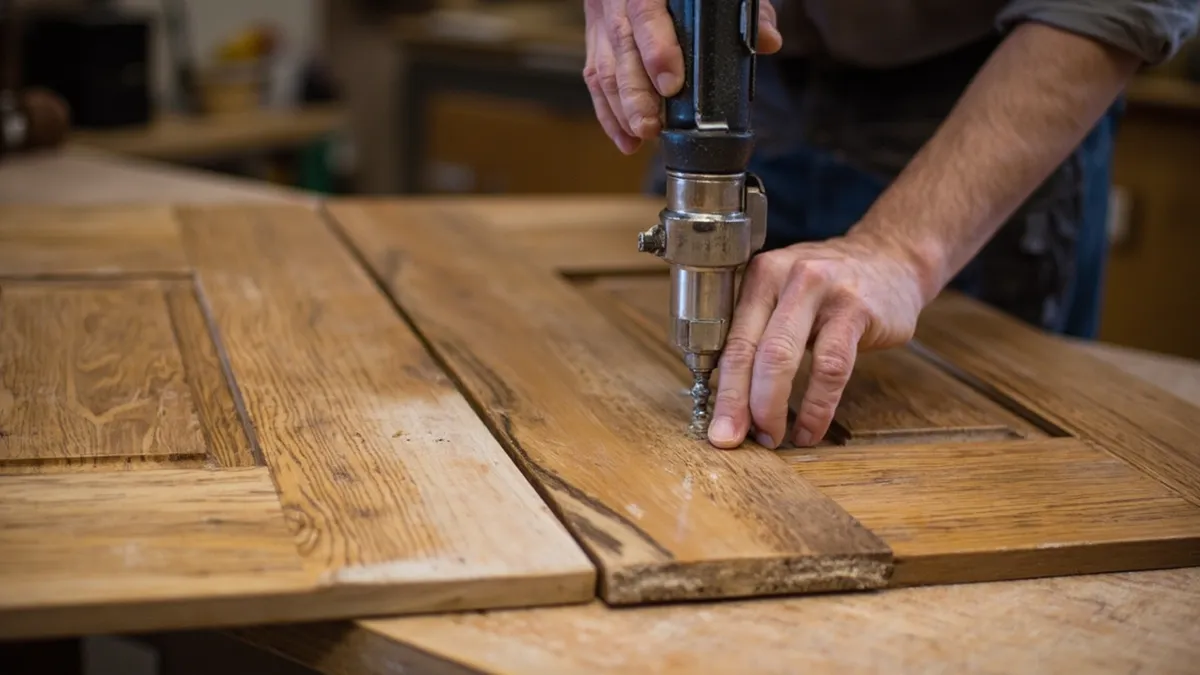
- Solid oak door with wear or loose joints: repair wherever the timber allows. Re-glue, splice and refinish.
- Oak veneer door with a tired finish but sound veneer: clean, lightly sand and refinish. Do not try to remove dents by sanding.
- Veneer door with local lifting or chips: re-glue and patch.
- Veneer worn through or delaminating across large areas: consider a new door, made in solid oak if it suits the house.
If you are not sure which you have, send us photos of the edges before anyone starts sanding. Our door restoration service covers solid and veneered doors, and where a new solid oak door is needed we can make it in our bench joinery workshop, using reclaimed or FSC-certified timber.
Not sure if your door is solid oak or veneer?
Send us a few photos of the face, the edges and any chipped corner, and we will tell you what you have and how far it can be refinished. Master craftsman Daniel Fitzpatrick, a Guild of Master Craftsmen member with over 30 years' experience, oversees every job, and advice is free.
Call 01484 666 333 or use our contact page, and read more about our oak and period door restoration. We work from Crossley Mills in Honley and cover homes across West and North Yorkshire.
Frequently asked questions
Is an oak veneer door real wood?
Yes, the surface is real oak. Veneer is a thin slice of wood glued onto a core, so what you see and touch is genuine timber. The core underneath is usually a different wood or an engineered board, which is why the door behaves differently from solid oak when sanded or trimmed.
Can you stain an oak veneer door darker?
Usually, yes. Clean off the old finish with the lightest possible sanding, test the stain on a hidden area such as the top edge, and apply it evenly. Veneer can take stain unevenly where it has been sanded thin, so test first.
Can you cut down an oak veneer door?
A little, but with care. Many veneered doors have solid lippings or rails at the edges that allow a small trim. Take off too much and you reach the core, which then needs a new lipping. Check how much solid edge there is before cutting.
Does a solid oak door warp?
Solid oak moves with changes in humidity, and a badly made or poorly seasoned door can twist. Well-made frame-and-panel doors allow for movement, with panels free in their grooves. Keeping all faces sealed and avoiding big swings in heating helps.