Newel Post Cap: Repairing or Turning a New One
By Daniel Fitzpatrick, Master Craftsman · Guild of Master Craftsmen
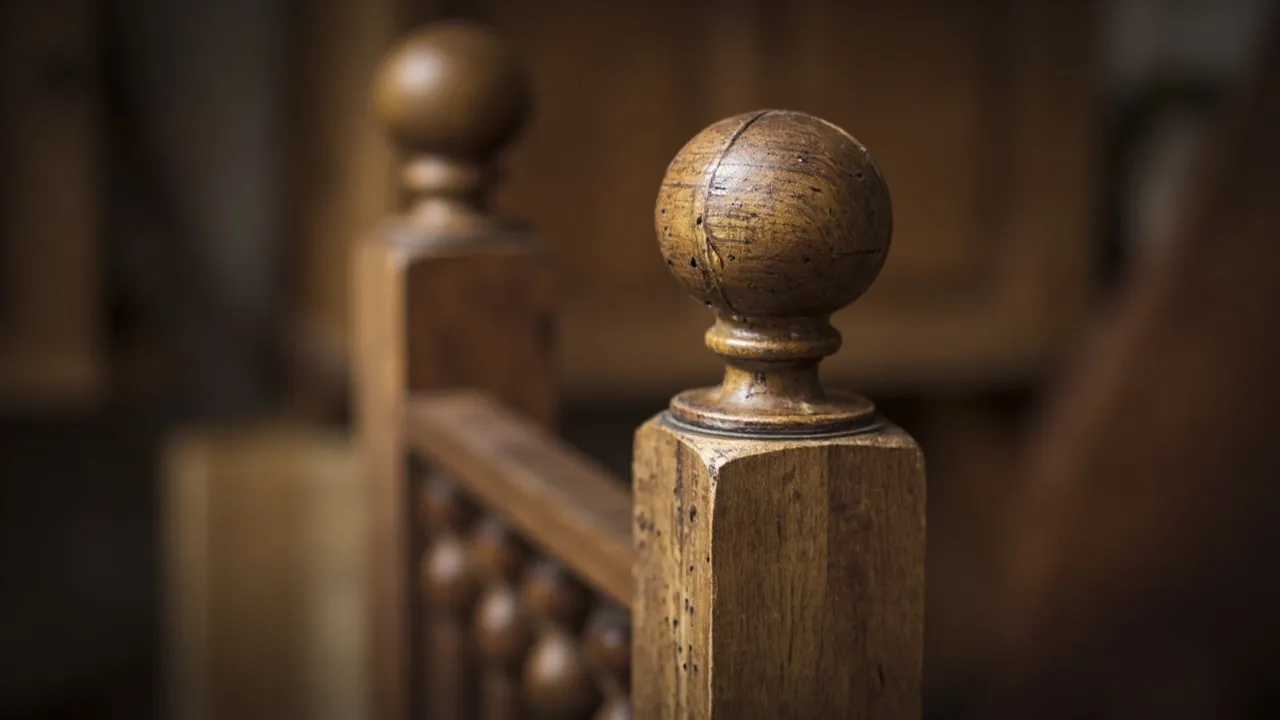
A newel post cap is the turned or shaped top that finishes a newel post. If yours is loose, it can usually be refixed with a new dowel; if it is split, glued and pinned; and if it is missing, a new one can be turned on a lathe to match the original.
Caps take a lot of knocks, because people grab them on the way up. In our workshop at Crossley Mills in Honley, we repair and turn newel caps for period staircases in Yorkshire. This guide covers the types of cap, what goes wrong, how a cap is fixed, which timber to use, and how we match a missing one.
Key takeaways
- A newel post cap is the decorative top of the post: commonly a ball, an acorn, a flat cap or a pyramid.
- Most loose caps were held on a dowel or peg that has failed; a new dowel and glue usually fixes them.
- A missing or badly split cap can be copied on the lathe from a surviving cap, a matching post elsewhere, or old photographs.
- Match the timber to the post: oak on oak, and the same species as the staircase wherever it can be identified.
What is a newel post cap?
A newel post is the upright post that supports or ends the handrail of a stair banister (Wikipedia, Newel). The newel post cap sits on top of it. In architectural terms it is a kind of finial: an element marking the top or end of something, often formed to be a decorative feature (Wikipedia, Finial).
On a period staircase the cap does two jobs. It finishes the post, covering the end grain so water from cleaning and hands does not soak in, and it gives the staircase its character. Newel post capping can be a separate piece fixed on, or it can be turned or shaped from the same length of timber as the post. Which one you have matters for repair, so it is the first thing we check. If you want to know more about the post itself, we cover that in our guide to oak newel post repair and replacement.
What types of newel cap are there?
Caps follow the style of the staircase. These are common shapes on period houses:
| Cap type | What it looks like | Typical setting |
|---|---|---|
| Ball | A turned sphere on a short neck and collar | Victorian staircases with turned newels and spindles |
| Acorn | A turned acorn or bud shape, sometimes with a cup | Victorian and Edwardian staircases, often on oak or pitch pine |
| Mushroom or flat turned cap | A low, rounded or flat-topped turned disc | Plainer Victorian and later staircases |
| Pyramid or square cap | A square block with a sloping, pointed or moulded top | Square newels on Edwardian and Arts and Crafts style stairs |
| Integral top | A shaped top worked from the post itself | Older and simpler staircases, cottages |
Ball, acorn and flat caps are turned on a lathe. Pyramid and square caps are mostly bench work, shaped with saws, planes and moulding tools, sometimes with a small turned element on top. We do both, which is why caps often pass between our woodturning lathe and the bench in the same job.
What goes wrong with a newel cap?
The same few problems come up again and again:
- Loose cap. The dowel or peg has worked loose or the old animal glue has failed. The cap wobbles or lifts off.
- Split cap. A split often runs along the grain from the dowel hole, usually after a knock or years of being used as a handle.
- Missing cap. Lost during a past renovation, broken and thrown away, or taken off for moving furniture and never put back.
- Wrong cap. A previous owner fitted a modern cap that does not match the post, the spindles or the staircase period.
- Worn or damaged finish. Layers of paint have filled the detail, or the top is worn through by hands.
A loose cap can also be a symptom. If the whole post moves, the problem is lower down in the newel joints, and fixing the cap will not help. Our guide on how to fix creaky stairs in an old house covers other movement in an old staircase.
How is a newel cap fixed?
Traditional caps are usually fixed with a turned dowel or peg. A hole is bored into the top of the post and the bottom of the cap, a hardwood dowel is glued into both, and the cap is pressed down so its base sits tight on the post. On square caps, a hidden screw from above is sometimes used, with the hole plugged and the plug grain matched.
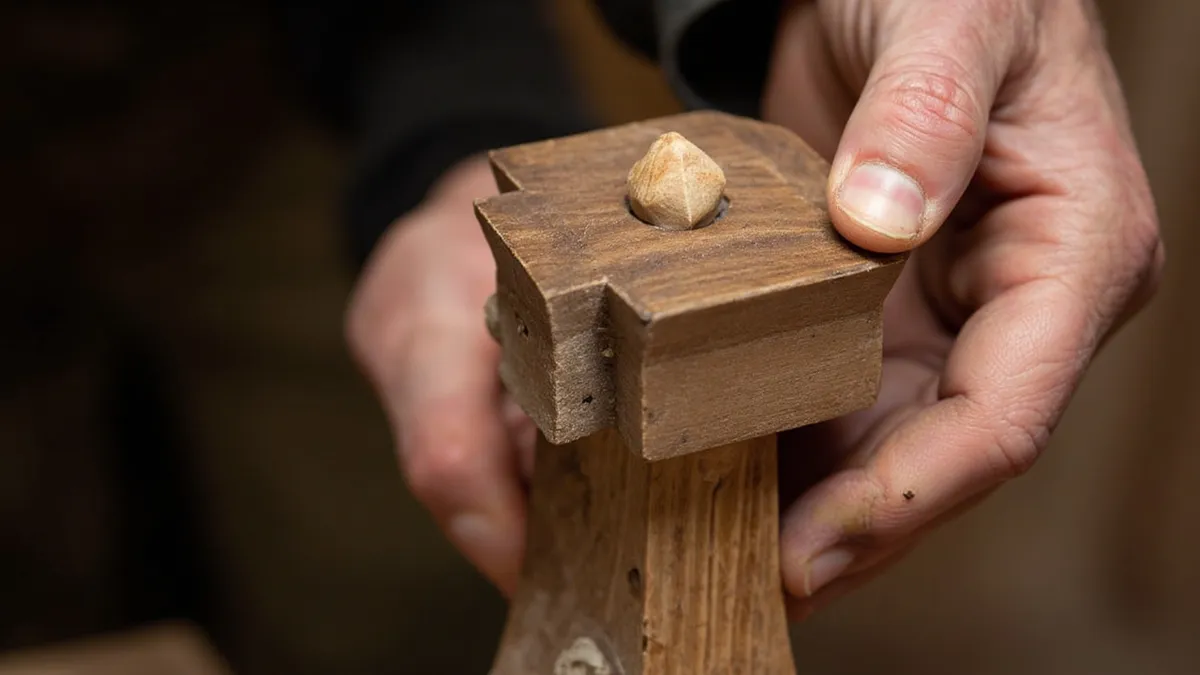
When we refix a loose cap, the steps are:
- Lift the cap off and clean the old glue out of both holes.
- Check the holes are sound. If they are worn oval, we bore them out and fit a larger dowel.
- Turn a new hardwood dowel to fit both holes snugly.
- Check the cap seats flat on the post, trimming the base if needed so there is no rock.
- Glue the dowel, fit the cap, and clamp or weight it while the glue cures.
- Touch up the finish so the joint line disappears.
We avoid fixing caps with long screws through the top, or with expanding foam or filler in a worn hole. They make the next repair harder and rarely last.
Can you replace a newel post cap?
Yes. If a cap is missing, wrong, or too badly damaged to repair, a new one can be made and fitted on a new dowel. The question is whether it should be bought or made. A standard stock cap rarely matches an old post, because many Victorian and Edwardian staircases were turned to their own proportions. Even a small difference in the diameter of the collar or the height of the neck shows straight away.
For a period staircase we recommend turning a new cap to match. Where a split cap still has most of its timber, we usually repair it instead: we open the split, glue it under clamp pressure, and if needed let in a small matching piece of timber. Keeping an original cap is usually better than replacing it. In a listed building, removing or replacing original features can need consent; under section 7 of the Planning (Listed Buildings and Conservation Areas) Act 1990, works that would affect a listed building's character as a building of special architectural or historic interest need authorisation (legislation.gov.uk, section 7). Check with your local planning authority or conservation officer before replacing original joinery.
How do we turn a matching newel post cap?
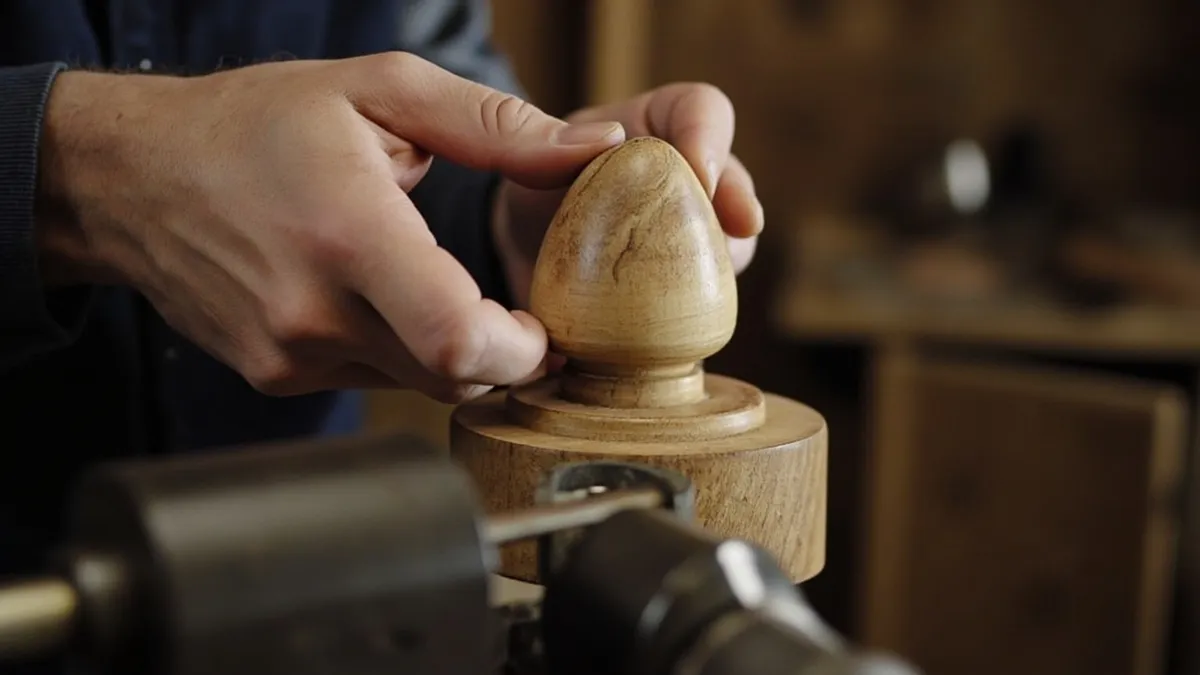
Matching a cap is where woodturning earns its keep. On our hand woodturning service, Daniel Fitzpatrick turns new caps in the Honley workshop to match the originals by eye and by measurement.
Taking the pattern
The best pattern is a surviving cap, either the damaged one or a matching cap on another post on the same stairs. We take the overall height, the diameters at each bead, cove and collar, and the profile of the curves. If no cap survives, we work from photographs, from caps on neighbouring houses of the same build, and from the proportions of the post and spindles.
Choosing the blank
We select a blank of the same species as the post, with straight grain and no shakes. Where possible we use locally sourced reclaimed timber, which is already seasoned and often closer in colour and grain to old stair timber. Where new timber is needed, we use FSC-certified stock.
Turning and finishing
The blank is mounted on the lathe and turned down to the profile, checking each diameter with callipers against the pattern. The dowel is turned as part of the cap or fitted separately, and the base is faced flat so it sits tight. Then we finish to match the staircase, whether that is a stain and wax, paint, or a polish. Our article on hand-turned balusters for Victorian staircases explains the same matching process for spindles, which often need doing at the same time.
What wood should a newel cap be made from?
Match the timber to the post. An oak newel post cap belongs on an oak post; a pine cap on a painted pine post. Mixing species shows through any clear finish, and woods move differently with the seasons, which can open the joint between cap and post.
- Oak: hard-wearing and common on better-quality Victorian and Edwardian stairs. Best for caps that take heavy daily use.
- Pitch pine and other pines: often found on terraced-house staircases, sometimes painted, sometimes stripped.
- Mahogany: used on some handrails and caps in grander houses; colour matching matters.
If the cap will be painted, the species matters less for looks but still matters for wear and stability. We would still choose a sound hardwood for a cap that people grab every day.
Why do Yorkshire staircases need matched caps?
Stone-built Victorian terraces and mill buildings around Huddersfield and the Holme Valley often have staircases that are plain but carefully proportioned, with turned newels and caps. Harrogate's Victorian and Edwardian villas tend to have grander stairs with larger newels and bolder caps. In Georgian and listed buildings in York and Wakefield, the staircase can be one of the most important surviving interiors. In all of them, a stock cap from a catalogue looks out of place. If you are local, see our pages for joinery in Huddersfield and Harrogate.
Our rule of thumb: refix, repair, then turn
Our workshop rule of thumb is simple. If the cap is whole and only loose, we refix it on a new dowel. If it is split but more than half of the original is sound, we repair it. Only when it is missing, wrong or broken beyond sensible repair do we turn a new cap, and then we turn it to match, not to a standard pattern. We also check the post every time: a cap fixed onto a loose newel will come loose again. For a full staircase project, our staircase restoration service covers posts, spindles and handrails together.
Need a newel cap repaired or turned?
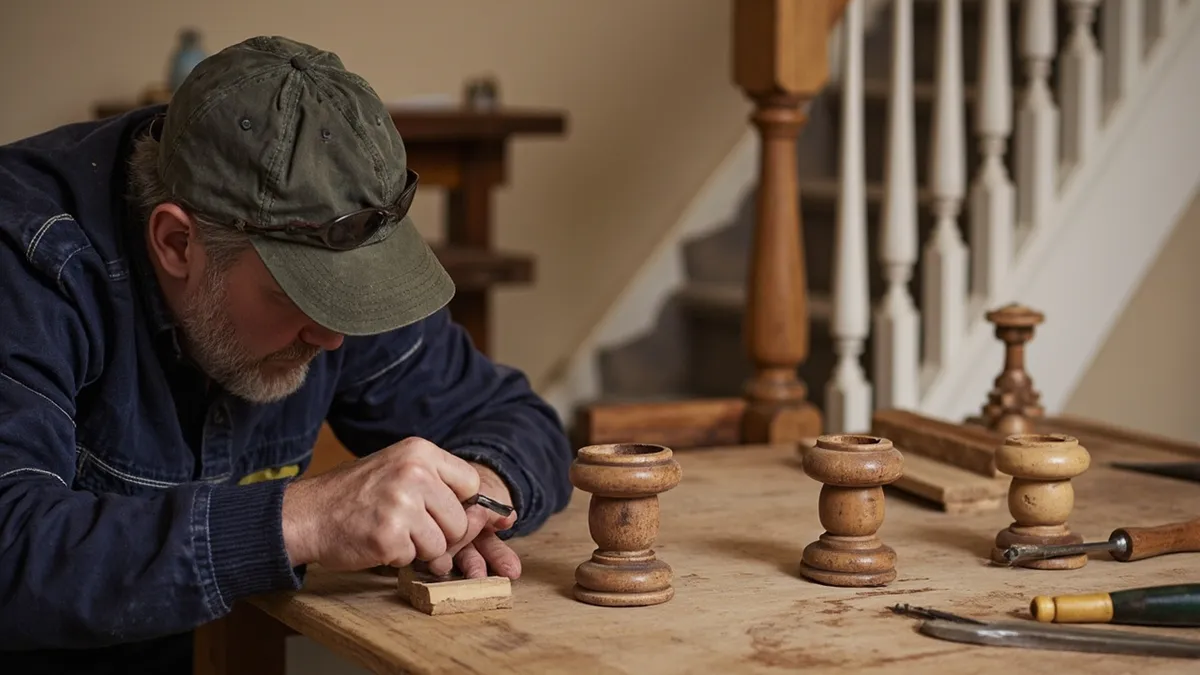
Daniel Fitzpatrick is a turner and bench joiner with over 30 years' experience and a member of the Guild of Master Craftsmen. He oversees every job from inspection to installation, and turns replacement caps in our workshop at Crossley Mills, Honley for staircases across Yorkshire.
Advice is free. Call us on 01484 666 333, contact us online with a photo of your cap and post, or read more about our bespoke woodturning in Yorkshire. Workshop visits are by appointment.
Frequently asked questions
Can I glue a loose cap back on myself?
If the dowel and holes are sound, cleaning out the old glue and regluing is a reasonable DIY job. If the hole is worn oval, the dowel is broken, or the post itself moves, glue alone will not hold. The hole needs boring out for a new dowel, or the post needs fixing first.
Can you match a newel cap from a photograph?
Often, yes. A clear photograph taken square-on, with something of known size in the frame, gives us the profile and proportions. We then check against the post and spindles. A surviving cap elsewhere on the stairs is still the best pattern, so we always ask whether one exists before working from photos.
Should a new cap be stained to match the old post?
Yes, if the staircase has a clear finish. New timber is lighter than old, so we stain and finish the cap to blend with the post. Reclaimed timber helps because it is already closer in colour. On painted staircases, the new cap is primed and painted with the rest.
Is a newel cap the same as a finial?
A newel post cap is a type of finial: a decorative piece that marks the top of the post. People use the words interchangeably for staircases. Some joiners use cap for a flat or square top and finial for a taller turned ball or acorn, but both are fixed in the same way.