Oak Newel Post: Repair, Replace or Turn a New One to Match
By Daniel Fitzpatrick, Master Craftsman · Guild of Master Craftsmen
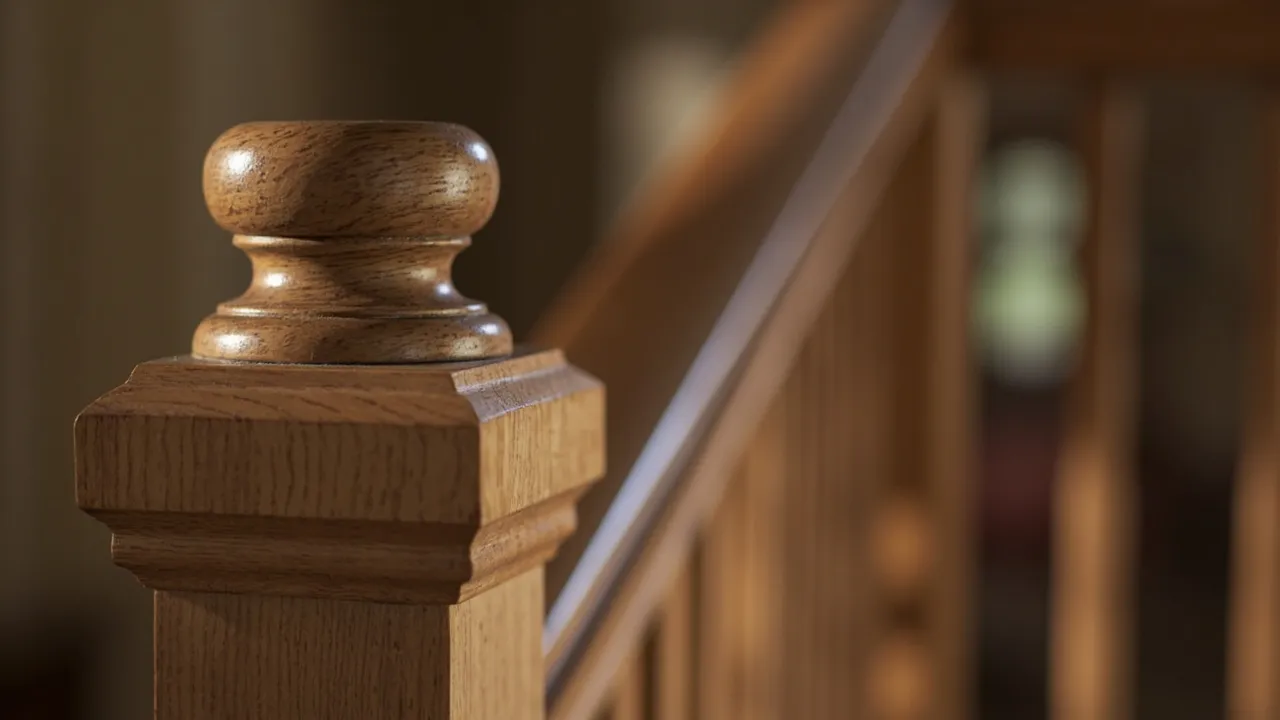
An oak newel post that wobbles, splits or loses its cap can usually be repaired rather than replaced. Most movement comes from loose joints or a failed fixing at the floor. Replace the post only when it is split through, rotten at the base or already missing.
Newel posts take a lot of knocks and strain, so they are a regular stair repair on period homes across Yorkshire. In our workshop at Crossley Mills in Honley we repair original newels, turn new ones on the lathe to match, and fix loose ones so they stay solid. This guide explains how to decide between repair and replacement, and what a proper fix involves.
Key takeaways
- A wobbly newel is usually a joint or fixing problem, not a failed post. Tightening the joints and fixing the base properly normally solves it.
- Splits, dents, a lost cap or a damaged base can be repaired with glue, a new cap or a spliced piece of matching oak.
- Replacing just the newel post is possible. A new one can be turned or made to match the original and jointed into the existing string and handrail.
- If the house is listed, check with your local planning authority or conservation officer before altering or replacing any part of the staircase.
What is a newel post?
A newel is, first of all, the central pillar that a winding stair turns around. Wikipedia explains that the word can also mean the upright post that supports or ends the handrail of a stair, which is the "newel post" most of us know. On a straight flight it is the main post at the foot of the stair, but the same name is used for the posts on landings and at the top (Wikipedia, Newel).
The same article notes that although a newel's main job is structural, newels have long been decorated and made in many architectural styles. It also describes two broad types: solid newels turned on a lathe, and hollow "box" newels (Wikipedia). That difference matters for repair: a box newel is mended like cabinet work, a turned newel more like a chair leg.
In a traditional staircase, the string and handrail are both jointed into the newel. So when a newel moves, it is often telling you about one of those joints rather than the post itself.
What goes wrong with an oak newel post?
Oak is hard-wearing, but an oak newel post still takes punishment: people swing on it, furniture is dragged past it, and many have been painted and stripped more than once. The faults we see most often are:
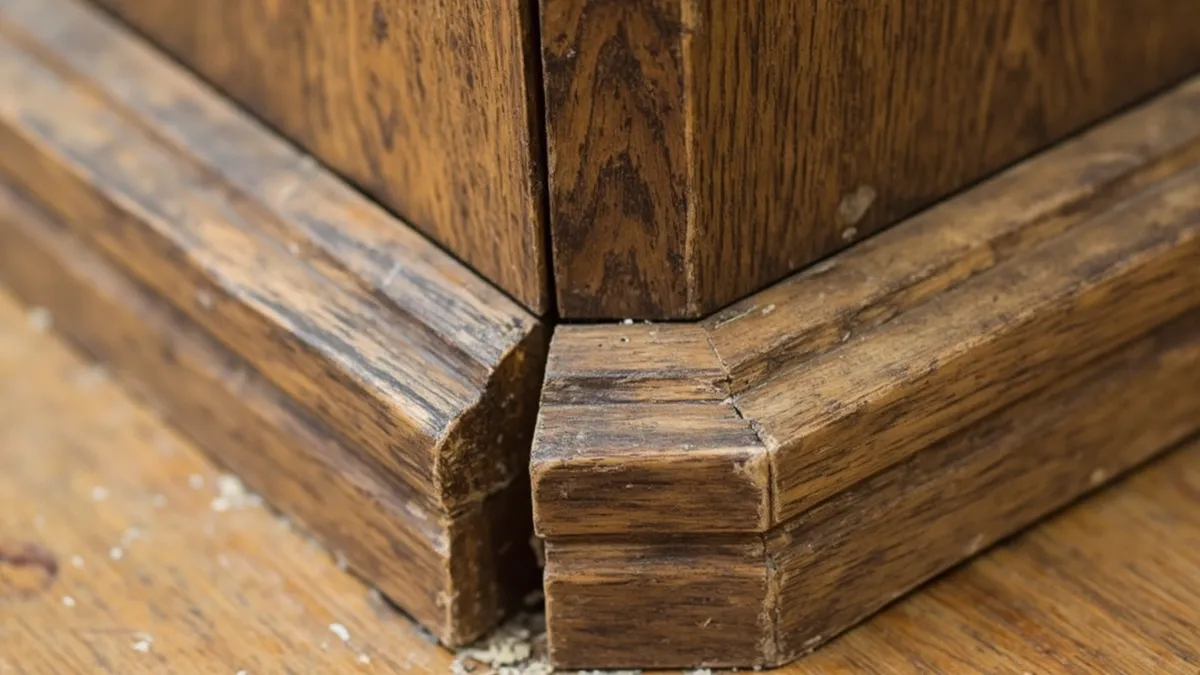
- Movement at the foot. The post rocks when you push the handrail, because the joint with the string or the fixing to the floor has worked loose.
- A loose handrail joint. The rail has pulled away from the post, often after years of people leaning on the landing balustrade.
- Splits and shakes. Cracks along the grain, sometimes following the line of an old joint or bolt hole.
- A lost or broken cap. Ball caps and finials get knocked off, glued back badly, or go missing altogether.
- Damage at the base. Bruising from vacuum cleaners and boots, or decay where a post in a ground-floor hall sits on a damp floor.
- Old repairs. Screws, plates, filler or brackets that hide the problem and damage the timber.
Here in Yorkshire we see all of these in the stone-built Victorian terraces and villas around Huddersfield and the Holme Valley, and in the Victorian and Edwardian houses of Harrogate. Cold, damp halls make the timber move with the seasons, and joints slowly open up. Wikipedia's newel article even illustrates an Arts and Crafts newel at Spring Hall in Halifax, a reminder of how much craft went into staircases in this part of the county.
How do you fix a loose newel post properly?
Find out which joint is moving before you do anything else. Brackets and long screws may stop the wobble for a while, but they can split the oak and hide the real fault. Our approach at the bench follows the same steps each time:
- Find the movement. One person rocks the handrail while the other watches the foot of the post, the string joint and the handrail joint. Gaps that open and close show you where the problem is.
- Look underneath. Where there is access from a cellar or through the under-stair cupboard, check how the post is fixed to the floor structure. Some older newels run down past the floor and are fixed to a joist or trimmer.
- Clean out the joint. Remove old failed glue, loose wedges and later screws so that timber meets timber again.
- Re-make the joint. Glue and re-wedge or re-pin the mortise and tenon joint between the string and the post, and the joint with the handrail, so the stair works as one frame again.
- Fix the base to the structure. If the post is not tied to the floor structure, fix it back to a joist or trimmer with a concealed fixing. Wikipedia notes that the most common way to fix a newel to the floor is a newel post fastener, which secures the post to a timber joist through concrete or timber flooring (Wikipedia).
- Plug and finish. Hide any fixing holes with oak plugs cut from matching timber, and blend the finish in.
This is a core part of our staircase restoration work. A newel that has been fixed at the joints stays solid, because the loads go back through the frame of the stair as the original maker intended.
Can you replace just the newel post?
Yes. Replacing an oak newel post does not mean replacing the whole staircase. The old post is carefully released from the string and handrail, and a new one is made with joints cut to fit the existing timbers. The treads, string, balusters and handrail all stay in place.
On a period stair the work is in the matching. We take the profile of the original post, or of a matching newel on the landing, and reproduce it. For a turned newel that means turning it on the lathe to the same shape. Our woodturning service is set up for exactly this kind of one-off copy work. A box newel is made at the bench, with the panels, mouldings and cap copied from the original.
We use FSC-certified timber where new timber is needed, and locally sourced reclaimed oak where it suits the job. Our guide to reclaimed oak in conservation joinery explains when that makes sense.
Repair or replace: our rule of thumb
We recommend repair whenever the original post is sound enough to carry the handrail once its joints are re-made. Our rule of thumb in the workshop is simple: if the damage is at the joints, the cap or the surface, we repair; if the post is split right through its section, rotten at the base or so cut about by past repairs that little original timber holds the joints, we make a new one to match.
| What you find | What it usually means | What we recommend |
|---|---|---|
| Post rocks when you push the handrail | Loose string joint or failed fixing at the floor | Re-make the joints and fix the base to the structure |
| Handrail has pulled away from the post | Failed handrail joint | Clean out, re-glue and re-fix the rail joint |
| Short split along the grain | Seasonal movement or an old screw or bolt | Glue and clamp the split, remove the cause |
| Cap broken or missing | Knock damage | Repair the cap or turn a new one to match |
| Soft or damaged timber at the base | Wear, impact or damp | Cut out and splice in matching oak |
| Post split through, or badly weakened by old repairs | The post can no longer hold its joints | Newel post replacement, made to the original pattern |
A splice repair keeps most of the original post and replaces only the damaged part with oak matched for colour and grain.
Why are newel posts so expensive?
A good oak newel post is a heavy, carefully made piece of joinery. Every staircase is different, so there is no fixed price, but the cost depends on:
- The timber. A newel needs a large, sound, dry section of oak without splits or defects, and that is costly to buy.
- The design. A plain square post is quicker to make than a turned, moulded or panelled one.
- Matching. Copying an existing profile exactly takes measuring, setting out and careful turning.
- Fitting. The joints have to be cut to fit an existing string and handrail that may not be square or level after a century of use.
- Finishing. Blending new oak with an old stained, waxed or polished staircase takes time.
This is also why repair is often worth it: it avoids most of the timber and making costs.
How much does an oak banister cost?
It depends on the length of the stair, the design of the balusters and handrail, and how much of the old work can be kept. Wikipedia notes that "banister" can mean a single baluster or the whole system of balusters and handrail, and that the word may also be used to include supporting parts such as the newel post (Wikipedia, Baluster). On a period stair, replacing a few damaged balusters or a section of rail usually costs far less than a new balustrade. Our article on hand-turned balusters for Victorian staircases explains how we match individual spindles.
If you are changing the balustrade rather than repairing it, the Building Regulations guidance may apply to the new work. Approved Document K says a handrail should be positioned with its top 900mm to 1000mm from the pitch line or floor. It also says that in a building that may be used by children under five, a 100mm sphere should not be able to pass through any openings in the guarding (GOV.UK, Approved Document K). Old balustrades often differ from these figures, so check with your building control body, and on a listed building your local planning authority or conservation officer, before changing the design.
Do you need permission to replace a newel post in a listed building?
Possibly. Under section 7 of the Planning (Listed Buildings and Conservation Areas) Act 1990, works to alter a listed building in any way that would affect its character as a building of special architectural or historic interest need to be authorised (legislation.gov.uk).
Councils take staircases seriously. One district council's listed building guidance states that alterations to staircases normally need listed building consent, and that it would be unlikely to support replacing a staircase unless it is post-war (Babergh District Council, listed buildings FAQs). Every authority decides for itself, so speak to your local planning authority or conservation officer before any work on a listed staircase. Our guide to listed building consent for timber repairs explains the process in more detail.
Before you call a joiner, have this ready:
- Photos of the whole staircase, the newel post and any damage close up.
- Which joint moves when you rock the handrail.
- Whether there is access to the underside of the stair or the floor below.
- Whether the house is listed or in a conservation area.
- Any matching newels elsewhere in the house that could be used as a pattern.
Free advice on your oak newel post
If your newel post wobbles, has split or has lost its cap, we can tell you whether it can be repaired or needs a new one turned to match. Master craftsman Daniel Fitzpatrick, a skilled turner and bench joiner with over 30 years' experience and a member of the Guild of Master Craftsmen, oversees every job from inspection to installation, and there is no charge for advice.
Call 01484 666 333, send photos through our contact page, or read more about our staircase and spindle restoration service. We work from Crossley Mills in Honley and cover Huddersfield, Holmfirth and towns across West and North Yorkshire.
Frequently asked questions
Can a split oak newel post be repaired?
Usually, yes. A split along the grain can be opened slightly, cleaned, glued and clamped closed, once the cause is removed. Common causes are an old screw, a bolt or seasonal movement. If the split runs right through the post and the joints no longer hold, a new post made to the original pattern is the better answer.
Why does my newel post wobble?
Most wobbling newels have a loose joint where the string or handrail meets the post, or the post has come away from the floor structure. Screws and brackets rarely cure it for long. The lasting fix is to re-make the joints and fix the base back to a joist or trimmer.
Can a new newel post be matched to an old staircase?
Yes. A turned newel can be copied on the lathe from the original or from a matching post elsewhere on the stair. A box newel is copied at the bench. Choosing oak with similar colour and grain, and blending the finish, makes the new post sit naturally with the old work.
Is it worth restoring an original newel post?
In most period houses, yes. The original post was made for that staircase, its joints fit the existing string and handrail, and it carries the character of the house. Repair usually keeps more of the history and costs less than making and fitting a new post.