Staircase Renovation: Restoring a Period Staircase
By Daniel Fitzpatrick, Master Craftsman · Guild of Master Craftsmen
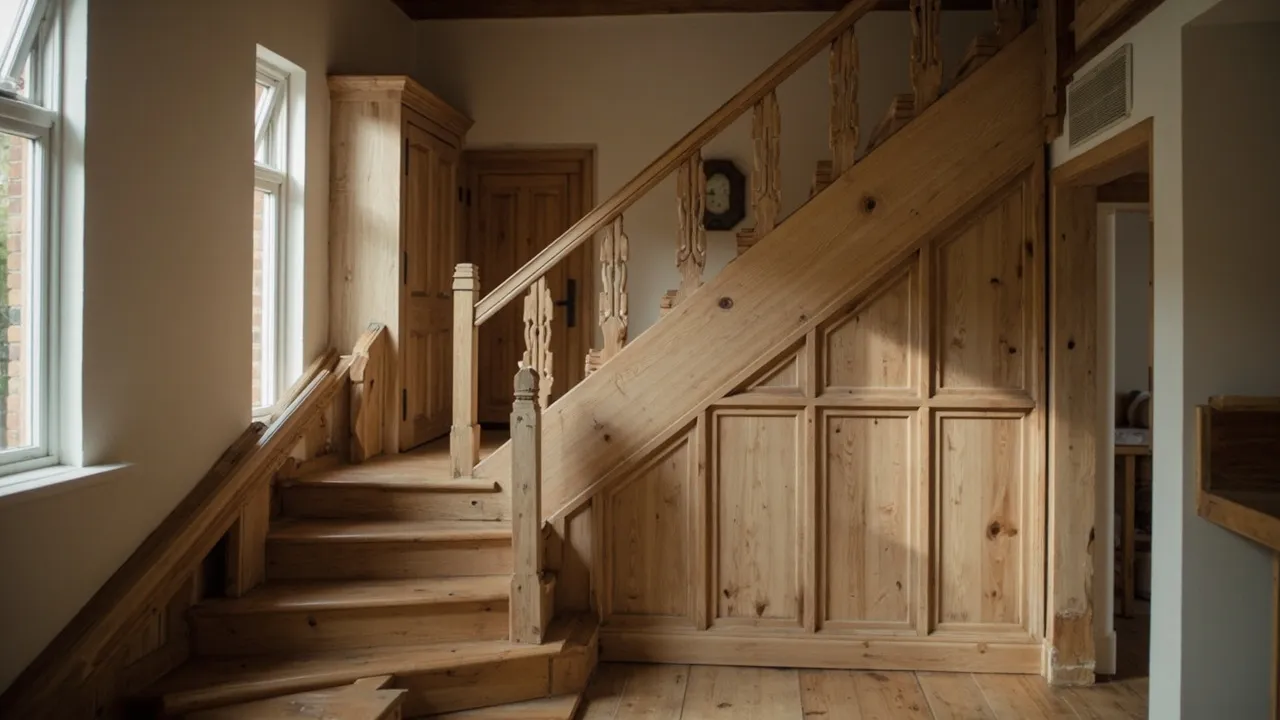
Staircase renovation on a period house works best as restoration, not a cover-up. Strip failed paint safely, repair loose treads and newels, replace missing balusters to match, then finish in paint, oil or stain. Repair keeps the original stair in use.
Many homeowners are offered cladding kits, new glass balustrades or a full replacement when all their stair really needs is careful repair. In our workshop at Crossley Mills in Honley, we restore Victorian and Georgian staircases for period homes across Yorkshire, and we turn replacement spindles on the lathe to match the originals. This guide explains what a restoration involves, what drives the cost, and when replacement is justified.
Key takeaways
- Many period staircases are structurally sound under the paint. Creaks, loose balusters and a wobbly newel are usually repairs, not reasons to replace.
- Old paint on a staircase may contain lead. Avoid dry sanding and blowlamps, and use wet methods or chemical strippers with proper dust control.
- Missing or broken balusters can be turned to match the originals, so the balustrade reads as one piece again.
- If the house is listed, fixed features such as the staircase are covered by the listing. Check with your local planning authority before altering it.
What does staircase renovation on a period house involve?
A staircase is more than the steps. Wikipedia's entry on stairs describes a staircase as one or more flights that includes landings, newel posts, handrails, balustrades and other parts (Wikipedia, Stairs). Each of those parts can wear, loosen or be damaged separately, so a good staircase renovation starts with a close look at every one of them.
Here is the order we work through on a typical period stair:
- Survey. Check the newel posts for movement, the handrail joints for gaps, each baluster for looseness or splits, and the treads and risers for creaks, wear and cracks.
- Test the paint. On older houses, assume the lower layers may contain lead until tested.
- Strip where needed. Take back only the surfaces that need it, using methods that keep dust and fume down.
- Repair the structure. Re-fix loose newels, re-glue and wedge treads, and tighten handrail joints.
- Replace missing parts. Turn or make new balusters, nosings or handrail sections to match the originals.
- Finish. Paint, oil, wax or stain, depending on the timber and the look of the house.
Put simply, staircase refurbishment done this way keeps what is original and only renews what has failed.
Victorian staircase or Georgian staircase: what are you working with?
Knowing the period helps you make repairs that look right. The details below are general trade observations, and many houses mix features from different dates, so treat them as a guide rather than a rule.
| Feature | Georgian staircase (typical) | Victorian staircase (typical) |
|---|---|---|
| Balusters | Slender, often plain square or finely turned, sometimes two or three per tread | Heavier turned balusters, often with more elaborate profiles |
| Newel posts | Often light, sometimes replaced by a curving handrail and scroll at the foot | Large, prominent newels, often turned, with a shaped cap |
| Handrail | Slim moulded rail, sometimes a polished hardwood such as mahogany | Wider moulded rail, often hardwood on a painted balustrade |
| Finish | Painted balusters and strings, polished handrail | Painted, grained or stained, depending on the house |
A Victorian staircase in a Huddersfield terrace and a Georgian staircase in a listed York townhouse need different profiles, different timber and sometimes a different finish. We aim to match what is there rather than impose a style.
Why choose staircase renovation over a cover-up kit?
Modernising kits usually fit new treads and risers over the old ones, or box in the balustrade. That hides the problem rather than fixing it. Loose treads still move underneath, and the extra thickness can make the top or bottom step a different height from the rest, a trip risk.
A proper staircase renovation keeps the original timber, which in older houses is often slow-grown and dense. It also keeps the details that make a period home worth living in: turned balusters, a shaped newel cap, a handrail polished by generations of hands. Once those are boxed in or thrown in a skip, they cannot be brought back without making them again from scratch.
Here in Yorkshire, we see a wide range of period stairs: stone-built Victorian terraces around Huddersfield and the Holme Valley, Victorian and Edwardian villas in Harrogate, and Georgian and listed buildings in York and Wakefield. If you are in one of those areas, our pages on heritage joinery in Huddersfield and joinery work in York cover the local work we do. The staircase and spindle restoration service is where most of this starts.
Our rule of thumb: restore, repair or replace?
We recommend a simple decision rule for any staircase renovation, based on what we see at the bench. If the strings and the main newel are sound, restore the staircase, however tired the paint looks or however many balusters are missing. Replace individual parts only where they are split, rotten or lost. We would only consider a new staircase when the strings themselves have failed or been badly cut about, and even then, on a period house, we would aim to reuse the original newels, handrail and balusters on the new flight.
How do you strip paint from a period staircase safely?
Carefully, because old paint on stairs may contain lead. The Society for the Protection of Ancient Buildings says lead paint was popular until the 1960s, particularly on timber, and might be present in nearly any pre-1960s building. It adds that dust from inappropriate sanding of old lead paint is the greatest hazard (SPAB, Lead paint).
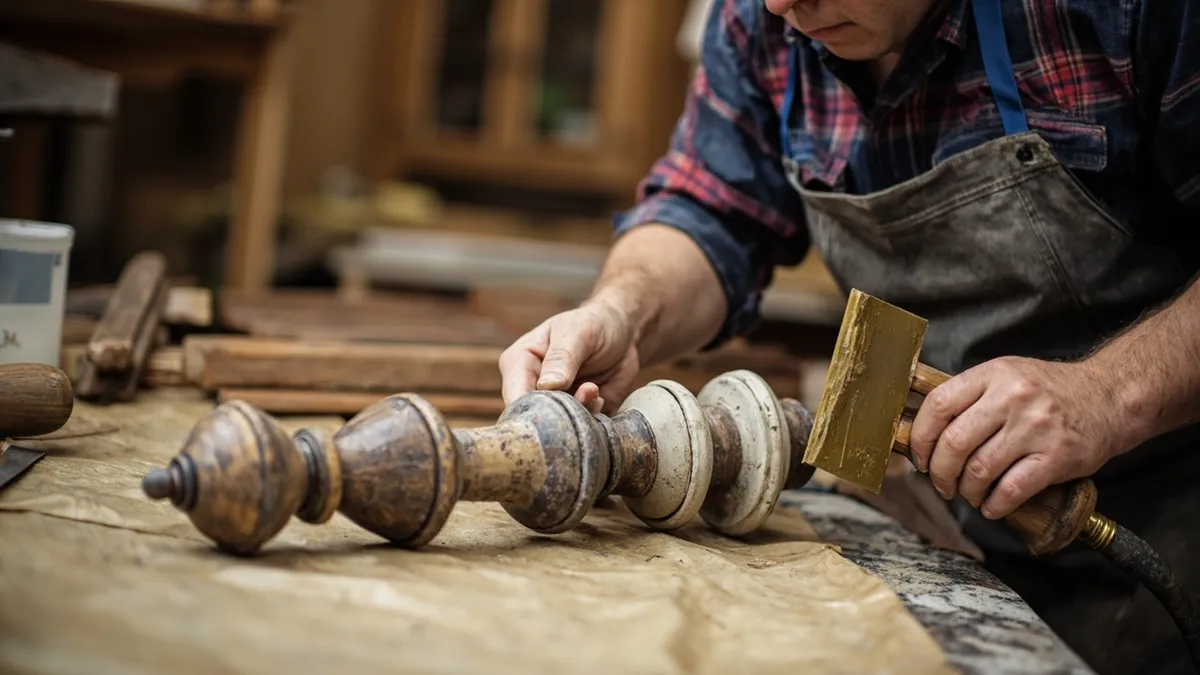
The Health and Safety Executive lists the jobs that put people most at risk: removing paint in properties built before the 1980s, stripping old paint with blow lamps or gas torches, and dry sanding old paint. It advises only stripping back old paint if it is flaking, chipping or a risk to children, and removing poor paint with a combination of chemical stripper, wet abrasive paper and on-tool extraction (HSE, Frequently asked questions on lead).
So a practical checklist for stripping a staircase looks like this:
- Test the paint before you start, especially on balusters and strings.
- Do not dry sand old paint and do not use a blowlamp.
- If the paint is sound, clean it and key it with wet abrasive paper rather than stripping it.
- Where stripping is needed, use a chemical stripper and wet methods, and clean off all residue.
- Keep children and pregnant women away from the work, and clear up with a damp cloth.
SPAB also makes a useful point for anyone tempted to rip everything out: the presence of lead paint does not justify stripping out historic joinery (SPAB). It notes that where lead paint is found, it could be safer to renew or overcoat it than attempt removal.
How are loose treads, creaks and wobbly newels repaired?
Many structural faults on old stairs come from glue failing and wedges shrinking over years of use. The fixes are traditional and quiet.
Creaking treads
A creak is usually a tread rubbing against a riser or a string because a joint has loosened. Where the underside of the stair is accessible, the treads can be re-glued and re-wedged into the strings, and glue blocks renewed between tread and riser. From above, the tread can be fixed down discreetly into the riser.
Worn nosings
The front edge of each tread takes the most wear. A badly worn or split nosing can be cut back and a new strip of matching timber let in, shaped to the original profile.
A loose newel post
Wikipedia describes the newel as a large baluster or post used to anchor the handrail (Wikipedia, Stairs). Because it carries the balustrade, a moving newel makes the whole rail feel unsafe. We find where the fixing has failed, whether at the floor, the string or the handrail joint, and re-make that joint rather than adding a bracket on the surface.
Handrail joints
Handrails are often joined with hidden bolts at bends and ramps. When these loosen, the rail can be taken apart, the joint cleaned and re-fixed, and any split sections spliced with new timber.
How do you replace missing balusters and spindles?
A baluster is an upright support, often a moulded shaft, square or lathe-turned, and a group of them supporting a rail is a balustrade (Wikipedia, Baluster). On period stairs, a few are often missing, split or replaced with a mismatched modern one.
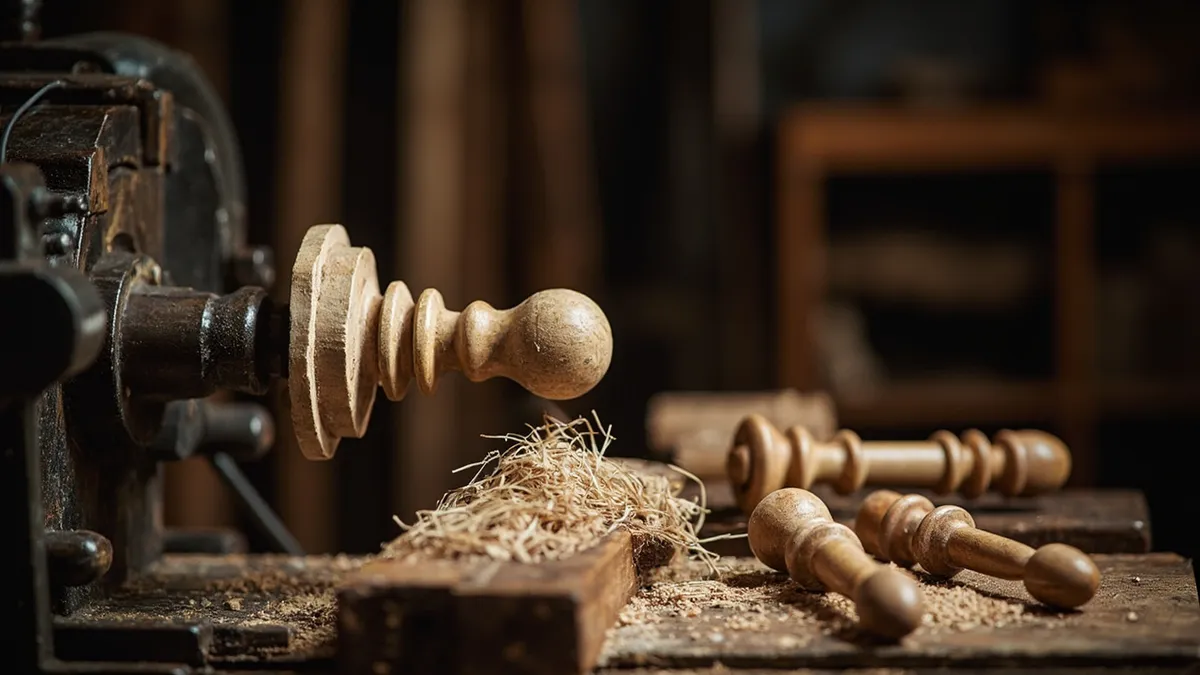
The right fix is a replacement turned to the same profile. We take an original baluster to the lathe, copy its beads, coves and tapers, and turn new ones in a matching timber. Our woodturning service does exactly this for spindles, balusters and newel details. Our guide to hand-turned balusters for a Victorian staircase explains the process in more detail.
If no original survives, we work from the pattern that sits best with the house and the rest of the stair, rather than a catalogue shape.
How much does staircase renovation cost?
Whether you ask how much it costs to refurb stairs or to restore them, we do not publish a fixed price, because no two stairs need the same work. The cost of a staircase renovation depends on:
- How much paint needs stripping, and whether lead precautions are needed.
- The number of missing or damaged balusters, and how complex the turned profile is.
- Structural work, such as re-fixing a newel or re-wedging treads, and whether the underside is accessible.
- The finish: a painted balustrade is quicker than a stripped and polished hardwood rail.
- Listed status, which can add time for drawings and consent.
As a rough guide to the question "how much does it cost to remodel a staircase?", remodelling means changing the layout, rise or balustrade design, and that usually involves far more new work than restoring what is already there. Send us photos and we can give you a clearer idea for your stair.
How can I modernise my staircase without losing its character?
People often search for staircase trends for 2026, but on a period house the most lasting approach is to modernise the finish, not the structure. Some options that keep the original stair intact:
- Paint the balusters and strings a strong colour and strip and oil the handrail, so the wood and paint contrast.
- Strip treads to bare timber and fit a runner up the centre, leaving the edges exposed.
- Restore the newel cap and handrail to a polished finish as a focal point.
- Improve lighting on the stairwell rather than altering the stair itself.
For finishing the timber afterwards, our guide to caring for heritage timber covers oils, waxes and paint.
Do I need consent to renovate a staircase in a listed building?
Possibly. The Planning Portal explains that the term "listed building" includes the building itself and any object or structure fixed to it. Listed building consent controls apply to any works for alteration that are likely to affect the building's character, and it is a criminal offence to carry out work that needs consent without getting it first (Planning Portal, Listed building consent).
Like-for-like repair of a staircase may not need consent, but removing balusters, changing the balustrade or replacing the stair very likely will. Always check with your local planning authority or conservation officer before starting. Our guide to listed building consent for timber repairs sets out the questions to ask.
Get free advice on your period staircase
If your staircase has loose balusters, a wobbly newel or layers of old paint, we can tell you what can be saved before you spend money on a kit or a replacement. Master craftsman Daniel Fitzpatrick, a Guild of Master Craftsmen member with over 30 years at the lathe and bench, oversees every job, and advice is free.
Call 01484 666 333, send photos through our contact page, or read more about our staircase restoration service. We work from Crossley Mills in Honley and cover Holmfirth, Huddersfield and towns across West and North Yorkshire.
Frequently asked questions
Can an old staircase be restored?
Usually, yes. Many period staircases have sound strings and newels under their paint. Loose treads can be re-glued and wedged, newels re-fixed, missing balusters turned to match and worn nosings pieced in. Replacement is only worth considering when the strings themselves have failed or been badly altered.
Is it safe to sand old paint off stair spindles?
Not by dry sanding. Paint in older houses may contain lead, and SPAB and the HSE both warn that dry sanding creates hazardous dust. Use wet abrasive paper, a chemical stripper and dust control, or leave sound paint in place and overcoat it. Test the paint first if you are unsure.
How long does staircase refurbishment take?
It depends on how much paint needs stripping, how many balusters need turning and whether the structure needs work. Turning new balusters happens in our workshop, so the time on site is often shorter than people expect. We give a clear programme once we have seen the stair.
Should I paint or stain a period staircase?
Follow what the house suggests. Many period stairs had painted balusters and strings with a polished or stained hardwood handrail. Where the timber is a good hardwood, stripping and oiling can look superb. Softwood stairs were usually intended to be painted, and paint often suits them best.