Victorian Internal Door: Restore or Replace?
By Daniel Fitzpatrick, Master Craftsman · Guild of Master Craftsmen
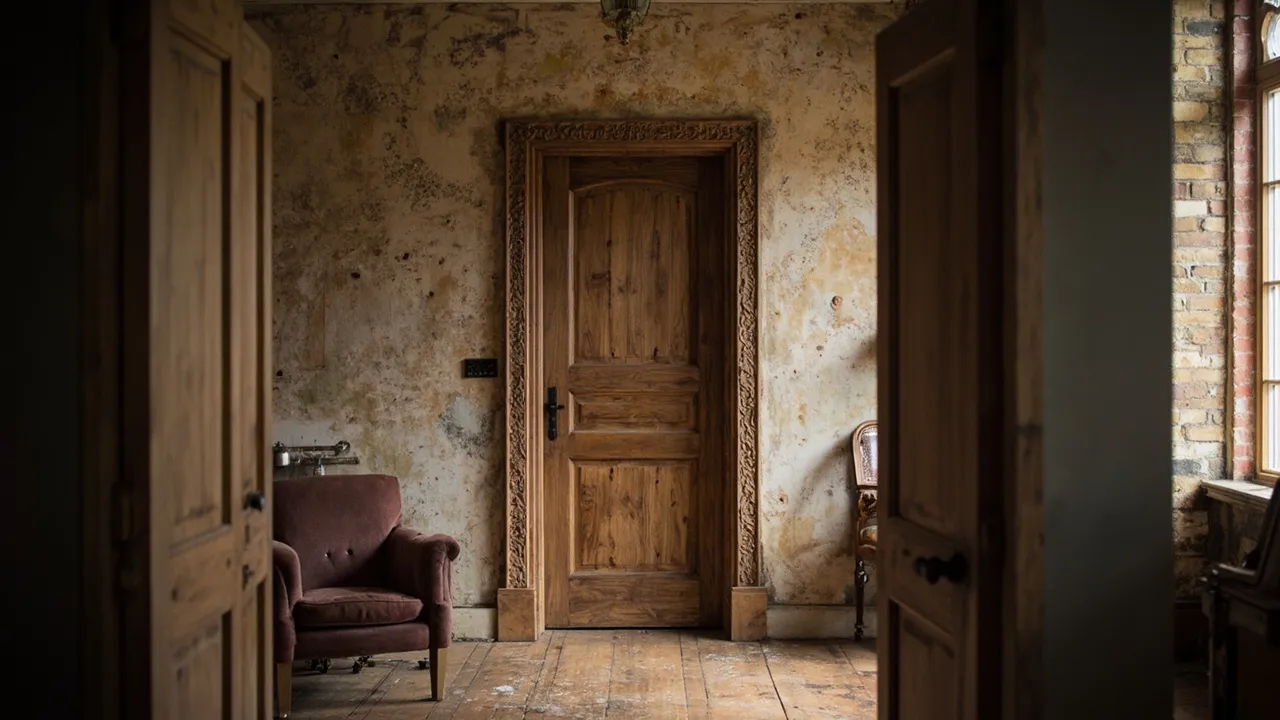
A Victorian internal door is usually worth restoring. Many are solid softwood four-panel doors with mortise and tenon joints, and paint build-up, sticking, loose joints or split panels can all be repaired for less disruption than fitting a convincing replacement.
Old houses across Yorkshire still have their original doors, often hidden under a century of paint. In our workshop at Crossley Mills in Honley we restore period doors for homes from Huddersfield to Harrogate. This guide helps you work out whether yours are original, what usually goes wrong with them, and whether to restore or replace.
Key takeaways
- Most original Victorian internal doors are four-panel softwood doors built with through mortise and tenon joints and solid timber panels.
- Sticking, rattling, sagging and split panels are common faults, and nearly all of them can be repaired.
- Old paint on a Victorian door may contain lead, so never dry-sand it. Overpainting sound paint is often the safest option.
- We recommend restoring an original door wherever the stiles and rails are sound; replacement is a last resort.
How do I know if my internal doors are original Victorian?
The typical Victorian internal door is a four panel door: two tall panels above, two shorter panels below, set in a frame of vertical stiles and horizontal rails. Framed doors of stiles and rails with panels set in grooves are a very old idea: the Wikipedia entry on doors traces the method back to the Roman writer Vitruvius (Wikipedia, Door). Victorian joiners used the same frame-and-panel construction, and it is the first thing to check.
Signs that a door is original:
- Solid timber throughout. Knock on a panel: a solid panel sounds dull and firm. A hollow, drummy sound suggests a later flush or moulded door.
- Through tenons. On the edge of the door you can often see the end grain of the rails passing right through the stile, sometimes with small wedges driven in beside them.
- Mouldings cut into the timber. Original mouldings around the panels are either worked on the edge of the stiles and rails or are separate strips pinned in. Pressed or printed "mouldings" give away a modern door.
- Slight irregularity. Hand-finished doors are rarely perfectly flat or square. Panels may have shrunk a little in their grooves, showing a line of unpainted timber at the edge.
- Old ironmongery marks. Filled holes from earlier locks, rim latches or larger hinges show the door has been in place a long time.
- Matching doors. A run of identical doors along a landing, all hung in the same way, usually points to the original fit-out.
Better rooms often had better doors. Doors to the front parlour might have raised panels or bolder mouldings on the hall side, while bedroom and back-of-house doors were plainer. If your door is a Victorian style internal door bought in recent decades, it will usually be lighter, made from glued-up sections or engineered board, and machine-perfect all round.
Victorian internal doors and front doors compared
Internal doors are thinner and lighter than front doors and rarely have glazing, except for doors into a hall or a kitchen corridor. If you want to identify an entrance door, our guide to Victorian front doors and their restoration covers the details.
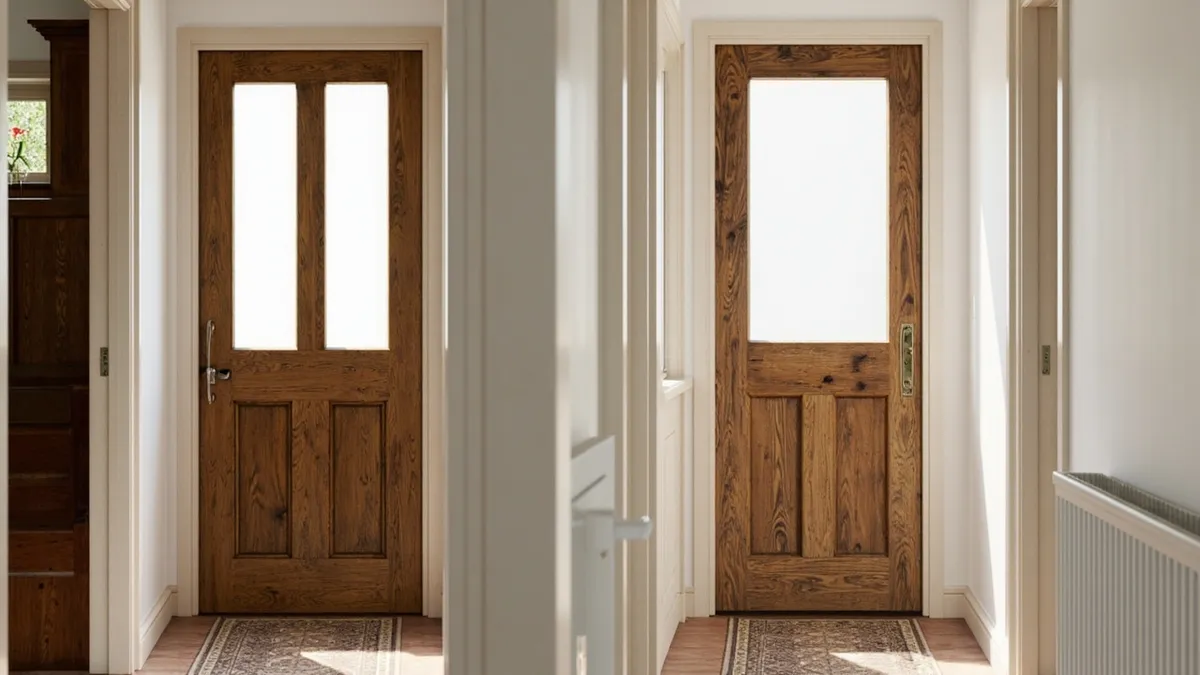
| Feature | Original Victorian internal door | Modern reproduction |
|---|---|---|
| Construction | Solid stiles and rails, mortise and tenon joints | Often dowelled joints, engineered or glued-up cores |
| Panels | Solid timber, free to move in grooves | Often board or moulded skins |
| Weight | Heavy and firm | Often lighter |
| Mouldings | Cut into the frame or pinned in by hand | Machined uniformly or pressed |
| Surface | Many layers of paint, small hand-made irregularities | One or two coats, perfectly flat |
What usually goes wrong with an old Victorian internal door?
After well over a century of use, the same faults come up again and again:
- Paint build-up. Layer after layer fills the mouldings and thickens the edges, so the door binds in its frame and loses its detail.
- Sticking and rubbing. Houses settle, frames move, and a door that once fitted starts catching at the head or the leading edge.
- Loose joints and sagging. When the wedges or glue in the tenons loosen, the door drops at the leading corner and scrapes the floor.
- Split panels. Panels that were painted into their grooves cannot shrink and swell freely, so they crack along the grain.
- Wrong hinges or hung on the wrong side. Doors are often rehung on undersized hinges, moved to a new opening, or flipped to suit a later layout, which strains the hanging stile.
- Old repairs. Cut-down bottom rails to clear carpets, plates screwed over damaged joints and filled lock holes are all common.
None of these mean the door is finished. They are wear, not failure.
Is it worth restoring old internal doors?
In most cases, yes. An original door was made from slow-grown timber, fits the house's proportions and carries the same mouldings as the architraves and skirtings around it. A replacement that matches all of that has to be made to measure anyway, which is why victorian door restoration is usually the better route.
Restoration also keeps a set of doors consistent. Replace one and it tends to look out of place beside the others. For listed buildings, original internal joinery may form part of the listing, so changes can need consent: check with your local planning authority or conservation officer before removing or replacing doors. Our guide to listed building consent for timber repairs explains when that applies.
How do you restore a Victorian internal door?
A full restoration at our workshop follows the same order every time:
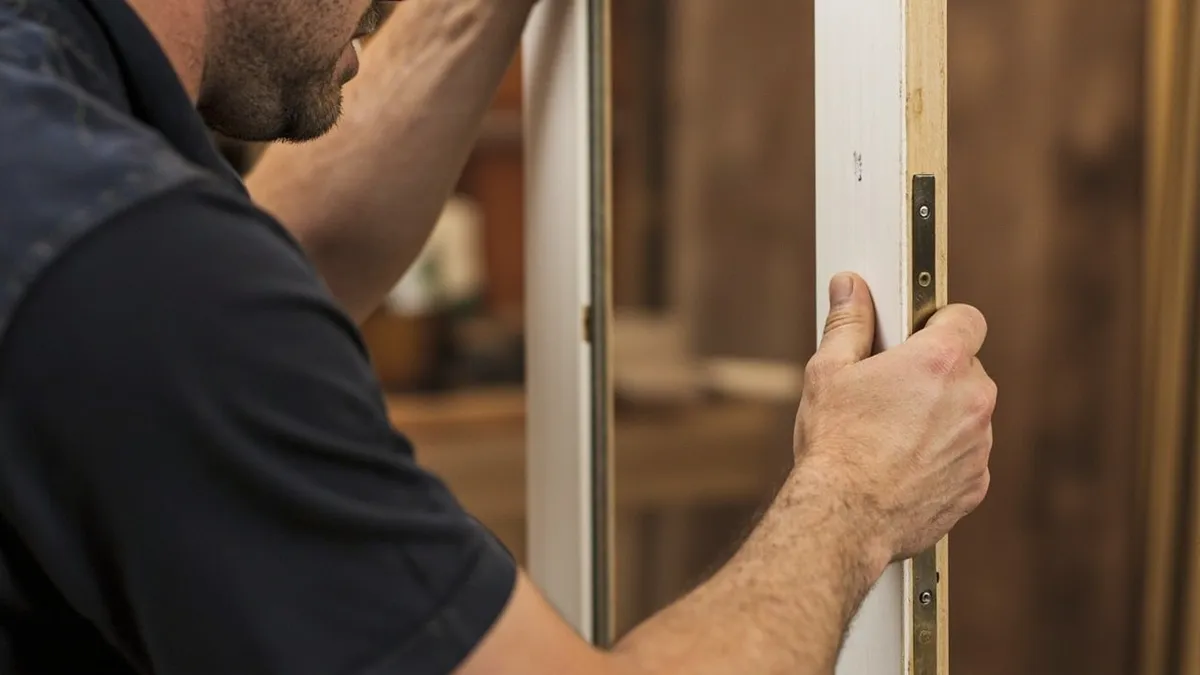
- Inspect in place. We check how the door hangs, where it rubs, the state of the frame and the hinges, and whether the problem is the door or the opening.
- Take it off and record it. Ironmongery comes off and is labelled. Any missing mouldings are noted so they can be matched.
- Deal with the paint. Either clean down and key the existing paint, or strip it where the build-up has buried the detail. More on that below.
- Re-glue and re-wedge loose joints. Loose tenons are cleaned out, glued and fresh wedges driven, then the door is clamped square. This cures most sagging doors.
- Repair panels and damage. Split panels are glued or fitted with a thin slip of matching timber. Missing mouldings are made at the bench to the original profile, and damaged sections of stile or rail are spliced.
- Fit and rehang. We plane only as much as needed, fit hinges of the right size, and adjust the frame if the opening has moved.
- Finish. Paint, or wax and oil for a stripped door, and refit the original ironmongery.
Where a short length of moulding or a turned knob is missing, we make it at the bench. Our bench joinery covers exactly this kind of matched replacement part.
Should Victorian internal doors be painted or stripped?
Most Victorian internal doors in ordinary houses were made from softwood and painted from the start, often with a grained finish to imitate oak. Stripped pine doors were a later fashion. So painting is historically correct, and stripping is a matter of taste.
Before stripping, think about lead. SPAB notes that lead paint was popular until the 1960s, particularly on timber, and that dust from sanding old lead paint is the greatest hazard. It also advises that it could be safer to renew or overcoat lead paint than to try to remove it (SPAB, Lead paint). HSE guidance is to only strip back old paint if it is flaking, chipping or a risk to children (HSE, Lead FAQs).
| Finish | Suits | Things to weigh up |
|---|---|---|
| Repainted over sound paint | Most doors, especially where mouldings are still crisp | Least disturbance of old lead paint; needs careful wet-keying |
| Stripped and repainted | Doors where paint build-up has filled the mouldings or stops the door closing | Brings back detail; needs lead-safe methods |
| Stripped and waxed | Good-quality timber with few repairs | Shows every filler and patch; not the original look in most houses |
If you are set on stripping, our article on door stripping, dipping vs hand stripping compares the methods and the risk dipping poses to glued joints. For the safety side, see our guide to stripping paint from period woodwork safely.
Why are Victorian doors in Yorkshire houses worth keeping?
Yorkshire has a large stock of stone-built Victorian terraces and mill-era housing, particularly around Huddersfield and the Holme Valley, and Victorian and Edwardian villas in Harrogate. Many of these houses still have original doors upstairs even where the ground floor has been modernised. Damp, cold Pennine winters and solid stone walls mean frames move with the seasons, so sticking doors are common. Usually the fix is easing and rehanging, not replacement.
We often find original doors stored in cellars and lofts after an earlier refit. If you have one, it can often be restored and refitted, or used as a pattern for a missing door.
Restore or replace: our rule of thumb
We recommend this simple decision rule from the workshop. If the stiles and rails are sound and the joints can be re-glued, restore the door. Split panels, missing mouldings, deep paint build-up and a bad fit are all repairable. Consider replacing only when:
- the door is a later replacement with no historic value, or
- rot or woodworm has destroyed a stile or several joints, or
- the door has been cut down so far that it no longer fits any opening in the house.
Even then, a new victorian internal door can be made at the bench to match the originals, with the same panel layout and mouldings, so the set stays consistent. Our door restoration service covers both the repair and the matched replacement.
Get free advice on your Victorian internal doors
Send us a photo of your doors and we will tell you whether they look original and what restoring them would involve. Master craftsman Daniel Fitzpatrick, a member of the Guild of Master Craftsmen with over 30 years' experience, oversees every job from inspection to installation, and advice is free.
Call 01484 666 333, get in touch through our contact page, or read more about our period door restoration. We work from Crossley Mills in Honley and cover homes across West and North Yorkshire.
Frequently asked questions
Were Victorian internal doors always four panel?
Four panels was the most common layout, but not the only one. Some houses have six-panel doors in the best rooms, and plainer ledged and braced doors to cellars, attics and service areas. Two-panel and glazed doors also turn up. Look at the other doors in the house to see what the original pattern was.
Can a sagging Victorian door be fixed?
Usually, yes. A sagging door has normally lost the grip in its mortise and tenon joints. Taking the door off, cleaning out the joints, re-gluing and driving new wedges, then clamping it square, cures most cases. Worn hinges or a moving frame can add to the problem, so we check those too.
Is it safe to sand an old painted door?
Not by dry sanding. Paint on a Victorian door may contain lead, and SPAB names dust from inappropriate sanding of old lead paint as the greatest hazard. Use wet abrasive paper to key sound paint, or a lead-safe stripping method if the paint must come off. If in doubt, test the paint first.
Can you match a new door to my existing Victorian doors?
Yes. We take the panel layout, moulding profile, thickness and timber from your existing doors and make a new door at the bench to match, so it sits alongside the originals without looking out of place.